The CamelBak M.U.L.E. 12 is my best overall pick among these mountain bike hydration packs because it balances trail-ready stability, useful storage, and ride-focused organization. The Osprey Raptor 10L is the stronger premium choice for riders who prioritize refined fit and tool management, while the CamelBak Hydrobak makes more sense for beginners and short rides. The central choice is between a compact pack that feels lighter and a larger design that carries tools, layers, food, and extra water. Riders also need to weigh low pricing against secure fit, ventilation, reservoir quality, and replacement-part availability. Continue reading for the full breakdown of which pack suits each rider, route length, and budget.
Complete the kit


Key Takeaways
- Bike-specific construction separated the leaders: the CamelBak M.U.L.E. 12, Osprey Raptor 10L, and Dakine Session 8L offer more convincing trail organization and stability than the general-purpose hiking and running packs.
- The M.U.L.E. 12 earned the top position through balance, while the Raptor 10L trades a higher price for a more refined premium package rather than a dramatic increase in carrying capacity.
- Compact CamelBak models split into different use cases: the Hydrobak is the easier beginner pick, while the 85-ounce Rogue gives established riders more water and storage without moving to a full day-pack format.
- The two-pack bundle offers the lowest cost per rider, but its basic fit and organization make it better for casual outings than rough, technical singletrack.
- Large 18- and 22-liter packs are specialized choices: the Everfun, Maelstrom, and Teton models can carry extra layers and supplies, yet their added bulk is unnecessary for most short trail loops.
| Zelvot Running Vest with 2L Water Bladder |  | Best for Wet-Weather Visibility | Water capacity: 2 L | Fabric: 900D Oxford | Pocket protection: Waterproof | VIEW LATEST PRICE | See Our Full Breakdown |
| Lightweight Hydration Backpack with 2L Water Bladder |  | Best Lightweight Value | Pack capacity: 12 L | Water capacity: 2 L | Weight: 8.5 oz | VIEW LATEST PRICE | See Our Full Breakdown |
| CamelBak M.U.L.E. 12 Mountain Bike Hydration Pack |  | Best Overall | Model: M.U.L.E. 12 | Reservoir capacity: 100 oz | Approximate water volume: 2.96 L | VIEW LATEST PRICE | See Our Full Breakdown |
| CamelBak Hydrobak Hydration Reservoir Bike Pack |  | Best Compact Pack | Reservoir capacity: 50 oz | Approximate water volume: 1.48 L | Reservoir type: Crux | VIEW LATEST PRICE | See Our Full Breakdown |
| CamelBak M.U.L.E. Mountain Bike Hydration Pack |  | Best for Adjustable Stability | Intended use: Mountain biking | Back panel: Air Director airflow channels | Waist support: Removable stability belt | VIEW LATEST PRICE | See Our Full Breakdown |
| MARCHWAY Tactical MOLLE Hydration Pack Backpack with 3L TPU Water Bladder |  | Best Modular Pack | Pack material: 1000D nylon | Weather treatment: Water repellent | Water capacity: 3L | VIEW LATEST PRICE | See Our Full Breakdown |
| Dakine Session Backpack 8L Mountain Bike Hydration Pack |  | Best Compact Gear Carrier | Pack capacity: 8L | Color: Black | Primary use: Mountain biking | VIEW LATEST PRICE | See Our Full Breakdown |
| CamelBak Rogue Bike Hydration Pack 85oz |  | Best for Fast Trail Rides | Reservoir capacity: 85oz | Design: Lightweight cycling pack | Back panel: Ventilated mesh | VIEW LATEST PRICE | See Our Full Breakdown |
| 2 Pack Hydration Backpacks with 2L Bladders |  | Best Two-Rider Value | Number of packs: 2 | Bladders included: 2 | Capacity per bladder: 2L | VIEW LATEST PRICE | See Our Full Breakdown |
| Everfun Hydration Backpack 18L with 2L Water Bladder |  | Best for All-Day Cargo | Pack capacity: 18L | Included bladder capacity: 2L / 70oz | Material: High-density water-resistant nylon | VIEW LATEST PRICE | See Our Full Breakdown |
| Osprey Raptor 10L Men’s Mountain Biking Backpack with Hydraulics Reservoir |  | Best Trail-Focused Pack | Pack Capacity: 10L | Reservoir Included: Yes | Reservoir Capacity: 2.5L | VIEW LATEST PRICE | See Our Full Breakdown |
| Maelstrom Lightweight Hydration Hiking Backpack with 2L/3L Water Bladder |  | Best for Organized Gear Storage | Pack Capacity: 20 liters | Bladder Capacity: 2L or 3L | Bladder Material: BPA-free | VIEW LATEST PRICE | See Our Full Breakdown |
| Unigear Hydration Pack Backpack with 70 oz 2L Water Bladder | 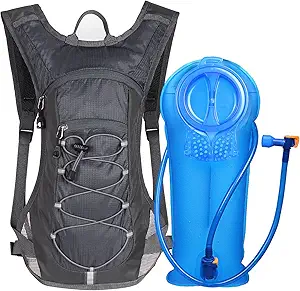 | Best Minimalist Pick | Hydration Capacity: 2 liters / 70 oz | Weight: 1.1 lbs | Material: Nylon | VIEW LATEST PRICE | See Our Full Breakdown |
| Teton Oasis/Trailrunner Hydration Backpack with 2L/3L Bladder |  | Best for Wet-Weather Day Rides | Storage Capacity: 18L or 22L | Bladder Capacity: 2L or 3L | Back and Strap Material: High-density foam and breathable mesh | VIEW LATEST PRICE | See Our Full Breakdown |
More Details on Our Top Picks
Zelvot Running Vest with 2L Water Bladder
I rank the Zelvot Running Vest as the wet-weather pick because its 900D Oxford fabric, waterproof pockets, and reflective accents protect small essentials while making a rider easier to spot near roads. Compared with the Lightweight Hydration Backpack, Zelvot offers tougher fabric and a two-year warranty, but it lacks that pack’s stated 12-liter gear capacity. The vest-style fit should limit bouncing on rough trails, and the adjustable waist and shoulder straps help stabilize the two-liter bladder. Still, this is a multi-sport design rather than a dedicated mountain bike pack: storage load limits are unclear, and fit may vary across body shapes. I would choose it for short, damp rides carrying a phone, keys, and snacks, while tool-heavy riders should favor the CamelBak M.U.L.E. 12.
Pros:- Waterproof pockets help protect a phone and small trail essentials
- Reflective accents improve visibility on road approaches and evening rides
- Durable 900D Oxford fabric suits frequent outdoor use
- Two-liter BPA-free bladder includes a high-flow bite valve
Cons:- No stated gear volume or weight limit makes packing capability hard to judge
- Vest fit may feel restrictive or unstable on some body shapes
- Multi-sport layout is less bike-specific than the CamelBak M.U.L.E. models
Best for: Short-ride mountain bikers who encounter rain, ride near traffic, and need protected pockets plus reflective detailing
Not ideal for: Riders carrying pumps, layers, and extensive repair equipment because the usable gear capacity and load limit are unspecified
- Water capacity:2 L
- Fabric:900D Oxford
- Pocket protection:Waterproof
- Bladder material:BPA-free
- Fit adjustment:Adjustable shoulder straps and waist belt
- Visibility:Reflective accents
- Valve:High-flow bite valve
- Warranty:2 years
Our verdict“I recommend Zelvot for visible, weather-ready hydration on shorter rides, but not for riders who need proven tool and layer storage.”
Lightweight Hydration Backpack with 2L Water Bladder
At 8.5 ounces, this Lightweight Hydration Backpack gives weight-conscious riders more room than its name suggests: the 12-liter pack capacity can hold repair supplies, food, and a light layer around the included two-liter bladder. I place it above Zelvot for budget-minded trail riders who value storage, since Zelvot does not state a gear volume. Breathable mesh and adjustable straps support longer wear, while waterproof, tear-resistant nylon adds useful protection without much mass. The compromises are fit and specialization. Its stated strap range may not suit larger torsos, and the generic multi-activity organization is less refined for bike tools than the CamelBak M.U.L.E. 12. There is also no tube-cleaning kit. I see this as the strongest low-weight utility choice, provided the harness dimensions suit the rider.
Pros:- Very low 8.5-ounce pack weight reduces shoulder burden
- Twelve-liter gear capacity is generous for a lightweight model
- Waterproof, tear-resistant nylon balances protection and low mass
- Leak-resistant two-liter bladder provides fast water flow
Cons:- Adjustment range may not accommodate larger torsos comfortably
- General-purpose compartments lack dedicated mountain bike organization
- No hydration-tube cleaning kit is included
Best for: Budget-focused riders with small-to-medium torsos who want a light pack with enough room for basic trail gear
Not ideal for: Larger-torso riders or cyclists wanting dedicated tool organization and a reservoir-cleaning kit
- Pack capacity:12 L
- Water capacity:2 L
- Weight:8.5 oz
- Material:100% nylon
- Shoulder strap range:19–34 in
- Chest strap range:2.4–7.9 in
- Back panel:Breathable mesh
- Reservoir design:BPA-free and leak-resistant
Our verdict“I would pick this for affordable, low-weight trail storage if its harness range fits, while demanding riders should step up to a bike-specific pack.”
CamelBak M.U.L.E. 12 Mountain Bike Hydration Pack
I put the CamelBak M.U.L.E. 12 first for riders who want one pack for demanding trail days. Its 100-ounce reservoir carries roughly twice the water of the compact CamelBak Hydrobak, while the multi-compartment layout has room for tools, food, and spare layers. The ergonomic fit and ventilation system address two common high-capacity problems: load movement and trapped back heat. Magnetic tube management also makes drinking simpler without leaving a loose hose to flap on descents. That capability carries a clear penalty. The M.U.L.E. 12 is bulkier than the Hydrobak and unnecessary for quick laps or commutes; buyers also receive no stated pack weight here. Compared with the general-purpose Lightweight Hydration Backpack, it earns the higher ranking through mountain-bike-specific storage and hose control, not minimal weight or simplicity.
Pros:- Large 100-ounce reservoir supports long rides between refill points
- Mountain-bike-specific compartments organize tools and trail supplies
- Ergonomic fit and ventilation help manage a loaded pack
- Magnetic tube retention keeps the drinking hose controlled and accessible
Cons:- Larger profile is excessive for short rides and commutes
- A full reservoir adds substantial weight to the rider’s back
- No pack weight is supplied, limiting direct weight comparisons
Best for: All-day trail riders carrying nearly three liters of water, repair tools, food, and an extra layer
Not ideal for: Short-loop riders and minimalists who would feel burdened by a larger pack and unused storage
- Model:M.U.L.E. 12
- Reservoir capacity:100 oz
- Approximate water volume:2.96 L
- Intended use:Mountain biking
- Fit system:Ergonomic
- Back system:Ventilated
- Tube management:Magnetic retention
- Storage:Multiple compartments
Our verdict“I rate the M.U.L.E. 12 highest for long mountain bike rides where water volume, stable fit, and organized storage outweigh compactness.”
CamelBak Hydrobak Hydration Reservoir Bike Pack
The CamelBak Hydrobak is my compact choice for riders who want water without turning every short outing into a packing exercise. Its 50-ounce Crux reservoir covers quick trail loops and commutes, while the air-mesh back panel and ventilated harness reduce the clammy feel common in simple hydration carriers. Compared with the CamelBak M.U.L.E. 12, the Hydrobak is easier to justify for an hour-long ride because it carries less bulk and keeps storage deliberately limited. That same simplicity sets its ceiling: one zippered pocket will not accommodate a substantial repair kit, jacket, and food, and the reservoir holds half as much as the M.U.L.E. 12’s 100-ounce system. I rank it behind that model for overall capability, yet ahead of larger packs for riders seeking minimal weight and close-fitting hydration.
Pros:- Compact profile stays unobtrusive on short rides
- Fifty-ounce Crux reservoir suits quick loops and daily commutes
- Air-mesh back panel improves airflow against the rider
- Zippered pocket secures a few small essentials
Cons:- Storage is too limited for substantial tools, food, or spare clothing
- Fifty-ounce water supply is insufficient for many long or hot rides
- Narrow use case offers less flexibility than either M.U.L.E. model
Best for: Commuters and short-loop riders who carry only water, keys, a phone, and a very small repair kit
Not ideal for: Backcountry riders who need high water volume, layered clothing, food, and a full set of repair tools
- Reservoir capacity:50 oz
- Approximate water volume:1.48 L
- Reservoir type:Crux
- Pack design:Lightweight and compact
- Back panel:Air mesh
- Harness:Ventilated
- Storage:Single zippered essentials pocket
- Intended ride length:Short rides and commutes
Our verdict“I favor the Hydrobak for short rides where a low-profile pack matters more than water volume or gear capacity.”
CamelBak M.U.L.E. Mountain Bike Hydration Pack
I give this CamelBak M.U.L.E. the stability-focused role because its removable waist belt and adjustable sternum strap let riders tune how firmly the pack stays planted over roots and drops. The Air Director back panel and ventilated harness make it better suited to sustained trail riding than Zelvot’s more general vest design, while the secure phone pocket adds protected, accessible storage. Against the newer M.U.L.E. 12, however, the supplied data leaves major questions: reservoir volume, total storage, and pack weight are not stated. That makes the M.U.L.E. 12 easier to judge for all-day capacity and explains its higher overall position. This older model still makes sense for riders who prioritize airflow and configurable support, but minimalists may prefer the smaller Hydrobak and multi-sport buyers may find its bike-specific shape less versatile.
Pros:- Removable stability belt lets riders choose more support or less bulk
- Air Director panel channels airflow across the back
- Adjustable sternum strap helps control movement on rough terrain
- Secure phone pocket keeps a key item protected and reachable
Cons:- Reservoir capacity, pack volume, and overall weight are not provided
- Pack can feel bulky for short rides compared with the Hydrobak
- Bike-focused design is less adaptable to running or casual hiking
Best for: Technical-trail riders who want adjustable torso stability, strong back ventilation, and secure phone storage
Not ideal for: Specification-focused buyers who need confirmed water capacity, pack volume, and weight before choosing
- Intended use:Mountain biking
- Back panel:Air Director airflow channels
- Waist support:Removable stability belt
- Harness:Lightweight and ventilated
- Chest adjustment:Adjustable sternum strap
- Phone storage:Secure dedicated pocket
Our verdict“I recommend this M.U.L.E. for riders who value adjustable stability and cooling, provided missing capacity details do not block the purchase.”
MARCHWAY Tactical MOLLE Hydration Pack Backpack with 3L TPU Water Bladder
I rank the MARCHWAY Tactical MOLLE Hydration Pack as the best modular choice because its webbing lets riders attach pouches or tools in a layout that suits their kit. The 3L taste-free TPU bladder carries more water than the 2L reservoirs supplied with the two-pack hydration backpacks, making this model better for hot rides or trails without refill points. Its 1000D water-repellent nylon also offers more abrasion resistance than lighter recreational packs. That durability comes with a compromise: this is a narrow, hydration-focused design, so it lacks the clothing and food capacity of the Everfun 18L. The tactical construction may also feel heavier and stiffer on fast rides. I place it behind more bike-specific packs for ventilation, but ahead of them for attachment flexibility and rugged materials.
Pros:- Rugged 1000D nylon resists abrasion and light moisture
- 3L TPU bladder supports longer rides between refills
- MOLLE webbing accepts modular tool and accessory pouches
- Adjustable straps and airflow features improve load stability
Cons:- Slim profile leaves little room for bulky ride gear
- Heavy-duty construction can feel weighty compared with minimalist cycling packs
- Tactical shape is less bike-specific than the Dakine Session or CamelBak Rogue
Best for: I recommend it to trail riders who carry extra tools or first-aid pouches and want 3L of water in a rugged, customizable pack.
Not ideal for: I would skip it for riders carrying spare layers, lunch, or bulky protective gear because its narrow body offers limited internal storage.
- Pack material:1000D nylon
- Weather treatment:Water repellent
- Water capacity:3L
- Dimensions:19.5 x 8.7 x 2.6 inches
- Reservoir material:TPU
- Reservoir characteristic:Taste-free
- Attachment system:MOLLE webbing
- Included equipment:Hydration bladder
Our verdict“I would choose the MARCHWAY for rugged hydration and modular storage, but not as an all-day cargo pack.”
Dakine Session Backpack 8L Mountain Bike Hydration Pack
The Dakine Session 8L earns its place by balancing a compact riding profile with enough dedicated storage for tools, snacks, and small accessories. I rate it above the CamelBak Rogue for riders who value gear organization over reservoir volume, while its 8L body remains far less cumbersome than the Everfun 18L. Adjustable straps help keep the load close during rough sections, and the durable construction suits repeated trail use. The catch is that its compact format limits spare-layer and all-day cargo space, and the supplied data only confirms hydration compatibility rather than an included reservoir. That makes it less complete out of the box than the MARCHWAY or two-pack set. Its minimal black design will appeal to understated riders, though anyone seeking extensive attachments or a large bladder should choose another pack.
Pros:- 8L format balances useful storage with a compact riding profile
- Dedicated compartments organize tools, snacks, and accessories
- Adjustable straps support a stable fit during active riding
- Durable outdoor construction suits repeated trail use
Cons:- Storage is too limited for bulky clothing or all-day equipment
- Product data does not confirm an included hydration reservoir
- Minimal layout offers less customization than the MARCHWAY MOLLE pack
Best for: I recommend it to mountain bikers who want an 8L pack for tools, snacks, and compact ride essentials without carrying a full daypack.
Not ideal for: I would skip it for buyers who need an included large reservoir or room for bulky layers on long backcountry rides.
- Pack capacity:8L
- Color:Black
- Primary use:Mountain biking
- Additional uses:Hiking and outdoor activities
- Hydration system:Hydration compatible
- Storage:Dedicated gear and accessory compartments
- Fit system:Adjustable straps
- Construction:Durable outdoor build
Our verdict“I would pick the Dakine Session for compact, bike-focused gear organization when an included reservoir is not a requirement.”
CamelBak Rogue Bike Hydration Pack 85oz
I give the CamelBak Rogue 85oz the fast-trail role because its ventilation, external refill flap, and magnetic tube retention address common on-bike annoyances. Riders can refill the reservoir without unpacking the bag, while the magnetic tube trap keeps the drinking hose accessible without letting it swing across the bars. Compared with the MARCHWAY, the Rogue sacrifices water volume and MOLLE flexibility for a lighter, more cycling-specific layout. It also carries less gear than the Dakine Session 8L, so I see it as a better match for short-to-medium rides where cooling and quick drinking matter more than cargo. The 85oz reservoir becomes noticeable when full, and limited pocket space rules out substantial layers or food. Still, its ventilated back panel gives it a comfort advantage over heavier tactical and high-capacity alternatives.
Pros:- 85oz reservoir provides useful range without a full-size daypack
- External refill flap speeds up water stops
- Magnetic tube retention keeps the hose controlled and accessible
- Breathable back panel reduces heat buildup
Cons:- Limited cargo space cannot handle bulky ride equipment
- A full 85oz reservoir adds noticeable weight
- Carries less water than the MARCHWAY 3L pack
Best for: I recommend it to trail and road riders who want quick tube access, strong back ventilation, and enough water for short-to-medium outings.
Not ideal for: I would skip it for self-supported backcountry riders who need extensive tool, clothing, and food storage.
- Reservoir capacity:85oz
- Design:Lightweight cycling pack
- Back panel:Ventilated mesh
- Refill access:External refill flap
- Tube management:Magnetic tube trap
- Storage:Multiple pockets
- Intended riding:Trail and road cycling
Our verdict“I would choose the CamelBak Rogue for streamlined hydration and ventilation on faster rides with modest gear needs.”
2 Pack Hydration Backpacks with 2L Bladders
This two-pack of hydration backpacks has the clearest value proposition in the group: two riders receive separate packs and 2L bladders in one purchase. At just 0.37 pounds each before water, the packs favor low dry weight and shared use over rugged construction or technical bike storage. Compared with the CamelBak Rogue, they offer less specialized tube management and trail-focused refinement; compared with the MARCHWAY, they give up a liter of water per rider and tougher 1000D fabric. Breathable mesh and adjustable straps suit casual rides, though dialing in the fit may take patience, and the lightweight nylon is a weaker match for repeated contact with rocks or branches. I rank this set for couples, families, and training partners rather than demanding solo riders. The multiple pockets add basic organization without turning either pack into a gear hauler.
Pros:- Two complete packs support two riders from one purchase
- Each 0.37-pound pack adds very little dry weight
- Breathable mesh panels help manage heat
- Multiple pockets separate small personal items
Cons:- Lightweight nylon is less rugged than the MARCHWAY’s 1000D fabric
- 2L per rider may be insufficient for long, hot outings
- Straps may need repeated adjustment to control movement
Best for: I recommend this set to couples, siblings, or training partners who need two lightweight hydration systems for casual rides at a low combined cost.
Not ideal for: I would skip it for aggressive trail riders who need abrasion-resistant fabric, bike-specific hose control, or more than 2L per person.
- Number of packs:2
- Bladders included:2
- Capacity per bladder:2L
- Combined water capacity:4L
- Material:Nylon
- Dry weight per pack:0.37 lbs
- Bladder design:Leak resistant
- Back panel:Breathable mesh
- Fit:Adjustable straps
Our verdict“I would buy this set for two casual riders who prioritize shared value and low weight over trail-grade durability.”
Everfun Hydration Backpack 18L with 2L Water Bladder
I assign the Everfun 18L Hydration Backpack the all-day cargo role because it has far more room for food, layers, tools, and personal items than the CamelBak Rogue or Dakine Session. Its insulated compartment can keep the 2L reservoir cold for up to six hours, while the included rain cover and reflective strips add useful protection and visibility when conditions change. That versatility pushes it ahead for long recreational outings, but not for riders seeking a barely-there race pack. At 1.74 pounds before water and gear, it starts heavier than the two-pack backpacks, and its 18.5-by-10.5-by-6-inch body may overwhelm a small frame or move more on technical descents. The adjustable straps aim for a bounce-free fit, yet careful packing still matters. I rank it as the highest-capacity choice, with bulk as the price of that flexibility.
Pros:- 18L capacity accommodates layers, food, tools, and personal gear
- Insulated compartment keeps liquids cold for up to six hours
- Included rain cover protects the pack in wet weather
- Reflective strips and adjustable straps support mixed-condition riding
Cons:- Large body can feel bulky on small riders and narrow trails
- 1.74-pound dry weight is high beside minimalist hydration packs
- Greater capacity can encourage overpacking and extra movement
Best for: I recommend it to all-day recreational riders who carry extra clothing, food, tools, and weather protection alongside a 2L water supply.
Not ideal for: I would skip it for small-framed riders, racers, and minimalists who want the lightest possible pack on technical trails.
- Pack capacity:18L
- Included bladder capacity:2L / 70oz
- Material:High-density water-resistant nylon
- Dry weight:1.74 lbs
- Dimensions:18.5 x 10.5 x 6 inches
- Insulation duration:Up to 6 hours
- Weather protection:Included rain cover
- Visibility feature:Reflective strips
- Fit system:Adjustable straps
Our verdict“I would choose the Everfun when all-day storage and weather readiness matter more than a compact, performance-focused fit.”
Osprey Raptor 10L Men’s Mountain Biking Backpack with Hydraulics Reservoir
I rank the Osprey Raptor 10L highest here for riders who value control on rough singletrack over maximum cargo room. Its bike-specific winged harness and wraparound hipbelt create a more stable trail fit than the general-purpose Maelstrom or Teton packs, reducing unwanted movement when descending or cornering. The included 2.5-liter Hydraulics LT reservoir covers typical day rides, while the tool roll keeps repair gear separated and quick to reach. That mountain-bike focus earns its place, but it also narrows the audience: 10 liters limits spare-layer capacity compared with the 18/22-liter Teton, and the structured harness may feel bulky on smaller riders. I would choose it for technical riding, not for riders seeking one large pack for biking, hiking, and travel.
Pros:- Bike-specific winged harness helps control pack movement on rough trails
- Wraparound hipbelt provides a secure fit during descents and cornering
- Included 2.5-liter Hydraulics LT reservoir suits most day rides
- Tool roll and internal compartments separate repair gear from other cargo
Cons:- 10-liter capacity is restrictive for gear-heavy or cold-weather rides
- Structured fit and 2.09-pound weight may feel bulky on smaller riders
- Less versatile for non-cycling activities than larger multipurpose packs
Best for: Mountain bikers who ride technical singletrack and want a secure, organized pack for day rides
Not ideal for: Smaller riders or backcountry cyclists carrying bulky layers, food, and emergency gear beyond a 10-liter load
- Pack Capacity:10L
- Reservoir Included:Yes
- Reservoir Capacity:2.5L
- Reservoir Type:Hydraulics LT
- Dimensions:18.9H x 9.8W x 9.1D inches
- Weight:2.09 lbs
- Harness:Bike-specific winged harness with wrap hipbelt
- Organization:Tool roll and multiple internal compartments
Our verdict“I would pick the Raptor 10L for technical trail riding where stability and tool access matter more than maximum storage.”
Maelstrom Lightweight Hydration Hiking Backpack with 2L/3L Water Bladder
The Maelstrom 20L makes my list for riders who dislike digging through one large compartment. Its front, upper, lower, helmet, and tool pockets give food, layers, and repair supplies defined places, while the insulated reservoir compartment helps water stay cooler during warm rides. Compared with the Osprey Raptor 10L, it offers twice the listed cargo capacity and greater everyday versatility, but its hiking-oriented suspension is less specialized for aggressive mountain biking. At two pounds, it is also much heavier than the 1.1-pound Unigear before either pack is filled. Reflective strips and a whistle add useful road-link and emergency visibility, yet the extra pockets can encourage overpacking. I see this as the organization-first choice for recreational trail days rather than a streamlined pack for fast, technical descents.
Pros:- Numerous dedicated pockets simplify access to tools, clothing, and ride essentials
- 20-liter capacity accommodates more day-ride gear than compact cycling packs
- Insulated bladder compartment helps slow water warming
- Reflective strips and built-in whistle add useful safety features
Cons:- Hiking-oriented design may move more on rough descents than the Osprey Raptor
- Two-pound base weight is high compared with minimalist hydration packs
- Included bladder may need replacement after extended use
Best for: Recreational mountain bikers who carry extra layers, food, tools, and a helmet and want dedicated storage for each
Not ideal for: Fast technical riders who prioritize a close, low-bounce bike-specific fit over pocket count and cargo capacity
- Pack Capacity:20 liters
- Bladder Capacity:2L or 3L
- Bladder Material:BPA-free
- Pack Material:High-density polyester
- Weight:2 pounds
- Insulated Compartment:Yes
- Visibility:Reflective strips
- Storage:Front, upper, lower, helmet, and tool pockets
- Emergency Feature:Built-in whistle
Our verdict“I recommend the Maelstrom to gear-heavy recreational riders who will trade some trail-specific stability for far better organization.”
Unigear Hydration Pack Backpack with 70 oz 2L Water Bladder
I would shortlist the Unigear Hydration Pack for short rides where carrying water matters more than hauling equipment. At 1.1 pounds with an included two-liter bladder, it is considerably lighter and less cumbersome than the 20-liter Maelstrom or 18/22-liter Teton. That low-bulk design suits quick training laps, smoother trails, and riders who already store tools on the bike. Adjustable straps broaden the fit range, while splash-resistant nylon offers basic protection from mud and light spray. The compromise is severe storage restraint: the small front pocket leaves little room for a pump, substantial food, spare layers, and protective gear together. Its two-liter supply also falls short of the Osprey Raptor’s 2.5 liters for longer outings. For my ranking, this is the simple hydration-first option, not a self-sufficient backcountry pack.
Pros:- 1.1-pound design adds less empty-pack weight than larger alternatives
- Included two-liter BPA water bladder provides a ready-to-ride hydration setup
- Adjustable straps accommodate different torso and chest sizes
- Splash-resistant nylon helps shield small belongings from spray and mud
Cons:- Small front pocket cannot accommodate a full day-ride equipment load
- Two-liter water capacity may be insufficient for long or hot rides
- General-purpose strap system lacks the trail stability of the Osprey Raptor
Best for: Minimalist riders taking short training laps who carry tools on the bike and need only water plus a few small essentials
Not ideal for: Remote-trail riders who need room for extra clothing, substantial food, repair equipment, and more than two liters of water
- Hydration Capacity:2 liters / 70 oz
- Weight:1.1 lbs
- Material:Nylon
- Dimensions:16.5 x 8 x 6 inches
- Water Bladder Included:Yes
- Bladder Material:BPA-free
- Bladder Closure:Screw cap
- Weather Protection:Splash-resistant pack material
Our verdict“I would choose the Unigear for short, light rides when low weight matters more than cargo space or advanced trail support.”
Teton Oasis/Trailrunner Hydration Backpack with 2L/3L Bladder
The Teton Oasis/Trailrunner earns its position through weather protection and flexible capacity rather than pure trail speed. A sewn-in rain cover and weather-guarded zippers offer better foul-weather coverage than the splash-resistant Unigear, while the 18- or 22-liter sizes leave ample room for a rain shell, food, and spare layers. The choice of a two- or three-liter bladder also suits longer rides better than a fixed two-liter minimalist pack. Compared with the Maelstrom, the Teton places more emphasis on rain defense and external bungee storage, though the Maelstrom provides more clearly separated pockets. Larger dimensions and a universal adjustable fit may feel cumbersome during hard cornering, especially beside the bike-specific Osprey Raptor. I would select this all-weather cargo option for changeable conditions and mixed outdoor use, not for racing or highly technical riding.
Pros:- Sewn-in rain cover provides more substantial weather defense than splash-resistant fabric alone
- Choice of 18- or 22-liter storage supports gear-heavy day rides
- Two- or three-liter bladder options let buyers match water capacity to ride length
- Breathable mesh and adjustable straps support extended mixed-activity use
Cons:- Large storage sizes can feel cumbersome on fast or technical trails
- Universal fit is less bike-specific than the Osprey Raptor harness
- Fewer defined organizational pockets than the Maelstrom may make small items harder to locate
Best for: All-day recreational riders in changeable weather who carry extra clothing and want an integrated rain cover
Not ideal for: Racers and aggressive singletrack riders who need a compact pack with a bike-specific harness and minimal movement
- Storage Capacity:18L or 22L
- Bladder Capacity:2L or 3L
- Back and Strap Material:High-density foam and breathable mesh
- Rain Cover:Sewn-in
- Zippers:Weather-guarded
- External Storage:Bungee cord system
- Fit:Adjustable for men, women, and youth
- Bladder Compartment:Insulated
Our verdict“I recommend the Teton for wet, gear-heavy day rides where weather protection and capacity outweigh compact trail handling.”

How We Picked
I ranked these packs by how well their designs address actual mountain-bike demands: stability over roots and drops, practical water access, ventilation during sustained climbing, and organization for tools, food, layers, and small emergency items. I gave added weight to secure fit and balanced capacity, since a large reservoir or low price has limited value if the pack shifts when the trail becomes rough. Reservoir access, hose routing, pocket placement, cleaning effort, build quality, and likely replacement support also shaped the order.
The highest positions went to packs that combine bike-focused usability with broad ride versatility. Compact models moved higher when their reduced bulk created a clear benefit for short rides, while large-capacity designs ranked by how well they justified their extra weight. General-purpose running, festival, hiking, and tactical packs placed lower because their feature sets are less closely matched to riding posture and trail movement. Price influenced the value awards, but I did not let low cost outweigh fit, durability, or ride control.
Factors to Consider When Choosing Mountain Bike Hydration Packs
Choosing between mountain bike hydration packs starts with matching the pack to ride duration, trail difficulty, and carried gear. Capacity figures alone can be misleading, so I focus on how water volume, cargo space, fit, and maintenance work together on the bike.
Match Water Capacity to Ride Length
A larger reservoir extends range, but it also adds weight high on the rider’s back and can make a loose-fitting pack move more. For short local loops, a compact reservoir and minimal cargo may feel better than carrying three liters simply because the pack permits it. Longer rides, exposed routes, and hot weather make extra water more useful, particularly when refill points are uncertain. I would also account for personal drinking rate rather than relying on a fixed miles-per-liter rule. Riders who drink frequently may prefer a larger bladder filled only as needed, which leaves flexibility for future routes. A common mistake is buying around maximum capacity while ignoring how the pack handles when the reservoir is half empty and the remaining water can slosh.
Choose Cargo Space Around a Real Packing List
Pack volume should follow the gear carried on a normal ride, not the largest load someone might carry once a year. A tube or plug kit, inflation tool, multitool, phone, keys, food, and a light layer quickly reveal whether a tiny pack will be frustrating. Riders who store tools on the bike can often use a smaller, steadier hydration pack, while photographers and all-day riders gain more from divided cargo space. Large open compartments sound versatile but allow hard items to settle or press into the back. Dedicated tool sleeves and small zip pockets create faster trailside access and reduce rattling. I suggest laying out a typical kit before choosing between compact models such as the Hydrobak and larger options such as the M.U.L.E. 12, Everfun 18L, or Teton packs.
Prioritize Stability Over Strap Count
A hydration pack should remain centered while climbing out of the saddle, cornering, and descending rough ground. Extra straps do not automatically create a better fit; strap placement, back-panel shape, load distribution, and adjustment range matter more. Bike-specific packs usually sit closer to the body than general hiking or tactical designs, reducing bounce without requiring excessive tightness. Running-vest styling can feel secure with light loads but may place pockets or buckles awkwardly against a mountain-bike riding posture. Taller packs can also interfere with helmets when riders look farther down a steep descent. I would favor stable movement and head clearance over a small difference in advertised pack weight.
Balance Ventilation Against a Close Fit
Back panels that hold a pack away from the body can improve airflow, yet too much separation may let the load sway. Foam channels and breathable mesh offer a middle ground by creating airflow paths while keeping the weight close. Riders in hot or humid areas should give ventilation greater priority, especially when the pack will be worn during long climbs. A compact design covers less of the back and may feel cooler even without an elaborate suspension panel. On rough trails, however, a softly structured pack can collapse as the reservoir empties and become less stable. The better choice balances heat management with load control rather than chasing the coolest-looking back panel.
Check Reservoir Access, Cleaning, and Parts
The reservoir affects ownership long after the first ride, so its opening, closure, hose connection, and drying process deserve close attention. A wide opening makes it easier to add ice, reach interior surfaces, and prop the bladder open after washing. Quick-disconnect hoses simplify reservoir removal, though each connection adds a seal that must stay clean and intact. Easy access encourages regular cleaning, which matters when riders use drink mixes rather than plain water. Established hydration brands may offer easier access to replacement valves, hoses, and reservoirs, while inexpensive bundles may make replacing the entire bladder more practical. I would pay more for serviceable parts and simpler maintenance if the pack will be used several times each week.
Know When a Higher Price Pays Off
Premium pricing makes the most sense for frequent riders who will benefit from better adjustment, structured tool storage, durable hardware, and replaceable hydration components. Occasional riders on smooth routes may receive little practical benefit from paying for advanced organization or a highly shaped back panel. At the budget end, the main risks are inconsistent fit, basic zippers, and limited parts support, not merely fewer pockets. A two-pack bundle can be sensible for couples, families, or loaner gear even if neither pack is the most refined. Midrange bike-specific models often provide the strongest balance because they avoid both excessive bulk and bare-bones construction. I would spend extra on comfort and stability before added volume, since those qualities affect every mile.
Frequently Asked Questions
Is a 2-liter or 3-liter reservoir better for mountain biking?
A 2-liter reservoir is usually enough for shorter rides, cooler conditions, and routes with known refill points. A 3-liter bladder offers more flexibility for hot days and remote trails, but three liters of water adds roughly three kilograms before tools and food. Riders do not need to fill a larger reservoir completely, though an underfilled bladder may move if the pack lacks compression. I would choose three liters for long or water-scarce rides and two liters when low weight and compact fit matter more. The pack’s stability under partial loads can be more important than the one-liter difference.
How much storage does a mountain bike hydration pack need?
Riders carrying only water, a phone, and a minimal repair kit can use a very small pack, especially if the bike already holds a tube and pump. Around 8 to 12 liters gives more room for food, tools, and a layer without becoming an expedition pack. Capacities of 18 liters or more suit long rides, changing weather, family gear, or bulky camera equipment. Extra space can tempt riders to overpack, creating more heat and movement on technical trails. I would select the smallest volume that holds a normal ride kit with a little space left for seasonal clothing.
Are running or hiking hydration packs suitable for mountain biking?
They can work for casual riding, but their pocket placement and load shape may not account for a cyclist’s forward-leaning posture. Running vests prioritize close body contact and front access, while hiking packs often favor upright comfort and larger cargo loads. A dedicated bike pack is more likely to provide helmet clearance, stable tool storage, and trail-focused hose routing. Multisport designs remain attractive when one pack must cover running, festivals, hiking, and cycling. I would choose a general-purpose model for versatility and low cost, but a bike-specific option for frequent singletrack use.
Is the Osprey Raptor 10L worth paying more for than a CamelBak M.U.L.E.?
The Raptor 10L makes sense for riders who place a high value on refined fit, organized storage, and a premium carry system. The M.U.L.E. line is the more broadly appealing choice because it balances trail features, capacity, and price without pushing as far into premium territory. The performance difference may feel small on short, smooth rides where either pack carries a light load. It becomes easier to justify the Osprey when the pack is used frequently, loaded with repair gear, or worn for long hours. I would pick the Raptor for premium refinement and the M.U.L.E. 12 for the stronger all-around value proposition.
Should I buy a compact pack or a larger pack with compression straps?
A compact pack is usually the better answer when most rides require only water and basic repair supplies. It covers less of the back, weighs less, and leaves fewer straps or loose sections to move on descents. A larger compressed pack offers more seasonal flexibility, but it may still feel taller, warmer, and less tidy than a purpose-built small model. Riders who alternate between one-hour loops and all-day routes may appreciate that flexibility enough to accept the added bulk. I would choose compact simplicity for routine rides and a larger compressible design only when the extra space will be used regularly.
Conclusion
For most trail riders, I would choose the CamelBak M.U.L.E. 12 as the best overall because it provides the most balanced mix of storage, stability, and mountain-bike utility. The two-pack hydration backpack bundle is the best value for couples, families, or riders who need inexpensive spare gear, though it gives up refinement on rough trails. Beginners and short-loop riders should start with the CamelBak Hydrobak, while the Osprey Raptor 10L is my premium recommendation for frequent riders who want stronger organization and fit adjustment. The Dakine Session 8L suits technical riders seeking compact, bike-centered storage, and the CamelBak Rogue 85-ounce model fills the gap between minimalist and mid-capacity packs. For long outings or bulky layers, the Everfun 18L and larger Teton options offer more carrying room, but their size is harder to justify on everyday loops. My final choice would follow ride length and cargo needs: M.U.L.E. 12 for versatility, Hydrobak for simplicity, Raptor 10L for refinement, and a larger pack only for genuinely large loads.