For most riders, I’d start with the Garmin Edge Explore 2: its cycling-focused navigation makes it the strongest all-around choice in this lineup. The Garmin Edge 540 is a better fit for riders who want more training-focused data, while the iGPSPORT BSC500 stands out for its large touchscreen and map-based navigation. Choosing a bicycle GPS means weighing route guidance and screen clarity against battery demands, setup complexity, and the cost of advanced features. Simpler wireless computers can cover ride tracking without the learning curve of a premium navigator, but offer fewer navigation tools. Read on for the full breakdown and my picks for different riding needs.

Get sports gear delivered free with Prime
- Fast, free delivery on millions of items
- Prime Video, Amazon Music and more included
- Member-only deals all year
Complete the kit


Key Takeaways
- The Garmin Edge Explore 2 is my best overall pick because this roundup’s clearest split is between cycling-first navigation and simpler ride tracking; it prioritizes route use over stripped-down speed-and-distance displays.
- Garmin’s Edge 540 and Edge 1050 serve different priorities. The Edge 540 leans toward training and data-focused rides, while the Edge 1050 is the premium choice for riders who want a larger, more advanced computer.
- iGPSPORT offers the strongest range of screen and navigation choices. The BSC500’s 3.3-inch touchscreen and map features stand apart from the more compact BSC100S and BSC200S options.
- Several entry-level and generic GPS units share a similar basic proposition: wireless ride tracking, a compact display, and fewer navigation refinements. Buyers should compare connectivity and interface details rather than assume similar-looking models work alike.
- Screen size and navigation capability are not the same thing. A larger display can make maps easier to read, but riders should also check route functions, sensor support, battery expectations, and how much setup they are willing to handle.
| iGPSPORT BSC200S GPS Bike Computer with Route Navigation |  | Best for Long Rides on a Compact Unit | Screen: 2.4-inch color display, 320 × 240 resolution | Dimensions: 82 × 53 × 14.1 mm | Weight: 67 g | VIEW ON AMAZON | See Our Full Breakdown |
| GPS Bike Computer Wireless Bicycle Speedometer Odometer with 2.4 Inch LCD, Waterproof, Supports MPH/KMH, 9 Languages |  | Best for Simple GPS Ride Tracking | Display: 2.4-inch LCD | Battery: 650 mAh rechargeable | Battery life: Up to 28 hours | VIEW ON AMAZON | See Our Full Breakdown |
| Garmin Edge Explore 2 GPS Cycling Navigator |  | Best for Map-Led Navigation | Screen: 3-inch capacitive touchscreen | Battery life: Up to 16 hours | Memory: 16 GB | VIEW ON AMAZON | See Our Full Breakdown |
| GEOID CC600 Wireless GPS Bike Computer with Color Screen |  | Best for Automatic Rerouting and Training Connections | Screen: 2.4-inch color LCD with Asahi glass | Battery life: Up to 24 hours | Ride-data storage: Up to 100 hours | VIEW ON AMAZON | See Our Full Breakdown |
| iGPSPORT BSC500 GPS Bike Computer – 3.3″ Touchscreen MAP Voice Navigation |  | Best for Large-Screen Voice Guidance | Screen: 3.3-inch touchscreen | Controls: Touchscreen and buttons | Data fields: Up to 12 displayed at once | VIEW ON AMAZON | See Our Full Breakdown |
| Wireless GPS Bike Computer with 2.4 Inch LCD, Waterproof, Auto Backlight, Supports MPH/KMH, 9 Languages |  | Best for Long Outdoor Rides | Display: 2.4-inch LCD with auto backlight | Battery life: Up to 28 hours | Connectivity: Wireless GPS | VIEW ON AMAZON | See Our Full Breakdown |
| iGPSPORT BSC300T Wireless GPS Bike Computer with Touchscreen and Offline Maps |  | Best for Offline Route Guidance | Screen: 2.4-inch touchscreen | Dimensions: 82 × 53 × 14.1 mm | Weight: 67 g | VIEW ON AMAZON | See Our Full Breakdown |
| L4 Entry Level GPS Bike Computer Wireless with 2.3″ Screen, Waterproof, Bluetooth & ANT+ |  | Best Lightweight Sensor-Ready Pick | Weight: 45 g | Thickness: 13.5 mm | Screen: 2.3-inch anti-glare | VIEW ON AMAZON | See Our Full Breakdown |
| COOSPO Bike Computer Wireless GPS Cycling Computer with Bluetooth/ANT+ Waterproof 2.4-inch LCD |  | Best for ANT+ Sensor Setups | Display: 2.4-inch LCD | Positioning: GPS and Beidou | Sensor connectivity: ANT+ | VIEW ON AMAZON | See Our Full Breakdown |
| CYCPLUS G1 Wireless GPS Bike Computer | 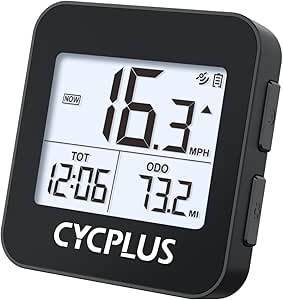 | Best for Minimalist, Long-Runtime Tracking | Display: 2-inch FSTN LED with backlight and tempered glass | Battery capacity: 1200 mAh | Battery life: 50 hours average; over 55 hours stated | VIEW ON AMAZON | See Our Full Breakdown |
| Garmin Edge 540 GPS Cycling Computer |  | Best for Training-Focused Riders | Screen: 2.6-inch LCD, 246 × 322 resolution | Controls: Buttons | Battery life: Up to 26 hours in demanding use; up to 42 hours in battery saver mode | VIEW ON AMAZON | See Our Full Breakdown |
| iGPSPORT BSC100S GPS Bike Computer Wireless, 2.6” LCD Display, 40H Rechargeable, Waterproof, Bluetooth & ANT+ |  | Best for Long-Ride Data Tracking | Display: 2.6-inch anti-glare LCD | Satellite support: GPS, BeiDou, GLONASS, Galileo, QZSS | Battery life: Up to 40 hours | VIEW ON AMAZON | See Our Full Breakdown |
| Bikevee Wireless GPS Bike Computer with 2.4-Inch Screen |  | Best for Simple GPS Ride Tracking | Display: 2.4-inch LCD | Battery capacity: 650 mAh | Battery life: Up to 28 hours | VIEW ON AMAZON | See Our Full Breakdown |
| Garmin Edge 1050 Premium Cycling Computer |  | Best Premium Navigation and Display | Screen: 3.5-inch LCD | Touchscreen: Capacitive | Battery life: Up to 20 hours in demanding use; up to 60 hours in battery saver mode | VIEW ON AMAZON | See Our Full Breakdown |
| Bikevee GPS Bike Computer with 2.4-Inch Display |  | Best for Basic Ride and Elevation Data | Display: 2.4-inch LCD | Battery capacity: 650 mAh | Battery life: Up to 28 hours | VIEW ON AMAZON | See Our Full Breakdown |
| bicycle gp | Battery life | Connectivity | Screen |
|---|---|---|---|
| iGPSPORT BSC200S GPS Bike Comp | Up to 25 hours | ANT+, Bluetooth, USB | 2.4-inch color display, 320 × 240 resolution |
| GPS Bike Computer Wireless Bic | Up to 28 hours | — | — |
| Garmin Edge Explore 2 GPS Cycl | Up to 16 hours | Bluetooth, Wi-Fi | 3-inch capacitive touchscreen |
| GEOID CC600 Wireless GPS Bike | Up to 24 hours | Wi-Fi, Bluetooth, ANT+, USB | 2.4-inch color LCD with Asahi glass |
| iGPSPORT BSC500 GPS Bike Compu | — | — | 3.3-inch touchscreen |
| Wireless GPS Bike Computer wit | Up to 28 hours | Wireless GPS | — |
| iGPSPORT BSC300T Wireless GPS | Up to 20 hours | ANT+, Bluetooth 5.0, USB Type-C | 2.4-inch touchscreen |
| L4 Entry Level GPS Bike Comput | 22 hours | Bluetooth and ANT+ | 2.3-inch anti-glare |
| COOSPO Bike Computer Wireless | — | — | — |
| CYCPLUS G1 Wireless GPS Bike C | 50 hours average; over 55 hours stated | — | — |
| Garmin Edge 540 GPS Cycling Co | Up to 26 hours in demanding use; up to 42 hours in battery saver mode | Bluetooth, Wi-Fi, USB | 2.6-inch LCD, 246 × 322 resolution |
| iGPSPORT BSC100S GPS Bike Comp | Up to 40 hours | Bluetooth 5.0 and ANT+ | — |
| Bikevee Wireless GPS Bike Comp | Up to 28 hours | GPS | — |
| Garmin Edge 1050 Premium Cycli | Up to 20 hours in demanding use; up to 60 hours in battery saver mode | Bluetooth, USB, Wi-Fi | 3.5-inch LCD |
| Bikevee GPS Bike Computer with | Up to 28 hours | — | — |
More Details on Our Top Picks
iGPSPORT BSC200S GPS Bike Computer with Route Navigation
The iGPSPORT BSC200S pairs route guidance with up to 25 hours of battery life, making it a strong fit for long day rides when a large screen is not the priority. Its 2.4-inch color display is smaller than the Garmin Edge Explore 2’s 3-inch touchscreen, but the BSC200S is lighter at 67 g and can retain up to 400 hours of ride data. ANT+ and Bluetooth sensor support, plus connections to compatible lights and radar, give it room to grow beyond basic speed and distance tracking. The tradeoff is a more app-dependent setup: some functions rely on iGPSPORT’s app, and the USB-C cable is not included. I’d choose it over the simpler GPS speedometer here for route planning and sensor support, but not for riders who want a large, map-focused display.
Pros:- Route creation and back-to-start guidance support planned rides and help with return trips.
- Up to 25 hours of battery life suits long day rides.
- ANT+ and Bluetooth support speed, cadence, heart-rate, and power sensors.
- Stores up to 400 hours of ride data and can connect to compatible lights and radar.
Cons:- The 2.4-inch display offers less map and data space than the Garmin Edge Explore 2’s 3-inch screen.
- Some features require the iGPSPORT app.
- USB Type-C charging cable is not included.
Best for: Road and gravel riders who want route guidance, broad sensor support, and enough battery for extended day rides in a compact computer.
Not ideal for: Riders who need a large screen for frequent map checks or want a setup that works without the iGPSPORT app.
- Screen:2.4-inch color display, 320 × 240 resolution
- Dimensions:82 × 53 × 14.1 mm
- Weight:67 g
- Battery life:Up to 25 hours
- Battery capacity:600 mAh
- Charging port:USB Type-C
- Data storage:Up to 400 hours of riding data
- Connectivity:ANT+, Bluetooth, USB
- Sensors:Speed, cadence, heart rate, power meter
Our verdict“Choose the BSC200S for compact route guidance and long battery life, but look to the Garmin Edge Explore 2 if screen size matters more.”
GPS Bike Computer Wireless Bicycle Speedometer Odometer with 2.4 Inch LCD, Waterproof, Supports MPH/KMH, 9 Languages
This wireless GPS bike computer is aimed at riders who mainly want speed, distance, and ride time without wiring a separate sensor. Its IPX7 waterproofing and stated battery life of up to 28 hours make it practical for outdoor rides in changeable weather, while the out-front mount places the 2.4-inch LCD within easy view. Compared with the iGPSPORT BSC200S, it offers a longer stated battery run time but lacks the listed route creation, back-to-start guidance, and broader sensor ecosystem. That makes it a more straightforward tracker, not a navigation-led computer. GPS dependence can also be a limitation in areas with poor reception, and the compact screen may feel cramped if you want to read several fields at once. I’d pick it for uncomplicated outdoor tracking, not for indoor training or route-heavy rides.
Pros:- Wireless GPS setup avoids wiring and supports core ride metrics.
- Up to 28 hours of stated battery life suits extended outdoor rides.
- IPX7 waterproof rating supports use in wet conditions.
- Out-front mount fits 25.4 mm and 31.8 mm handlebars.
Cons:- GPS reception is required for operation and may be affected by poor signal conditions.
- The listed features focus on outdoor tracking rather than navigation or indoor training.
- The 2.4-inch LCD may feel small for riders who want more information visible at once.
Best for: Casual outdoor cyclists who want wireless GPS speed, distance, and ride-time tracking with a weather-resistant unit and simple handlebar setup.
Not ideal for: Riders who need turn-by-turn route guidance, indoor cycling support, or reliable tracking in places with weak GPS reception.
- Display:2.4-inch LCD
- Battery:650 mAh rechargeable
- Battery life:Up to 28 hours
- Languages:9, including English, German, French, Italian, and Spanish
- Mount:Out-front mount
- Handlebar fit:25.4 mm and 31.8 mm
- Tracking:GPS ride metrics including speed, distance, and ride time
Our verdict“Pick this computer for basic, weather-ready GPS tracking, but choose the iGPSPORT BSC200S if you want route guidance and sensor connections.”
Garmin Edge Explore 2 GPS Cycling Navigator
The Garmin Edge Explore 2 puts navigation ahead of dense training data. Its 3-inch touchscreen gives maps and searchable points of interest more room than the 2.4-inch displays on the iGPSPORT BSC200S and GEOID CC600, while bike-specific maps include road, off-road, and eBike routing. A glove- and rain-friendly interface helps when conditions or handwear make smaller controls awkward. Smartphone pairing adds LiveTrack, GroupTrack, notifications, and music control; incident detection and Varia compatibility add safety options. The tradeoff is a shorter stated battery life of 16 hours, well below the BSC200S’s 25 hours, and several safety or training functions depend on separately purchased accessories. I’d favor it for riders who prioritize readable maps and connected ride features, but not for those planning very long outings without charging.
Pros:- The 3-inch touchscreen gives maps and route details more space than the 2.4-inch iGPSPORT BSC200S and GEOID CC600.
- Preloaded bike-specific maps include road, off-road, and eBike routing.
- Searchable points of interest make route planning and on-ride detours easier.
- LiveTrack, GroupTrack, incident detection, and Varia compatibility add connectivity and safety options.
Cons:- The stated 16-hour battery life is shorter than the iGPSPORT BSC200S’s 25 hours.
- Sensors and Varia accessories are separate purchases.
- Full connected features depend on pairing with a compatible smartphone.
Best for: Touring, commuting, and eBike riders who want a large touchscreen, searchable map points, and smartphone-linked safety features.
Not ideal for: Riders planning very long rides between charges or anyone seeking a full sensor and Varia setup without buying additional accessories.
- Screen:3-inch capacitive touchscreen
- Battery life:Up to 16 hours
- Memory:16 GB
- Connectivity:Bluetooth, Wi-Fi
- Navigation:GPS with bike-specific maps, searchable POIs, and eBike routing
- Activity profiles:Road, off-road, and indoor
- Smartphone features:LiveTrack, GroupTrack, smart notifications, and music control
- Safety compatibility:Incident detection and Garmin Varia integration
Our verdict“Choose the Edge Explore 2 if map readability and connected navigation matter more than battery endurance or an all-in-one accessory package.”
GEOID CC600 Wireless GPS Bike Computer with Color Screen
The GEOID CC600 makes sense for riders who want route guidance that can respond when a ride goes off plan. Its GPX support and automatic rerouting give it a more navigation-focused role than the basic wireless GPS speedometer, while five satellite systems support positioning across varied riding environments. Wi-Fi, Bluetooth, and ANT+ cover a broad mix of sensors, smart trainers, radar, and electronic shifting systems; indoor workout targets and FIT exports also make it useful beyond outdoor navigation. Compared with the iGPSPORT BSC200S, the CC600 lists fewer hours of ride-data storage—100 versus 400—but adds smart-trainer compatibility and automatic rerouting. Its 2.4-inch screen remains compact beside the Garmin Edge Explore 2’s 3-inch display, and some positioning and navigation features depend on current AGNSS data. I’d choose it for connected training and rerouting, not for maximum onboard history or a large map view.
Pros:- GPX navigation includes turn reminders and automatic rerouting.
- Five satellite systems support positioning across different riding conditions.
- ANT+, Bluetooth, and Wi-Fi connect a wide range of sensors, trainers, radar, and electronic shifting systems.
- Indoor workout targets and FIT export support training workflows beyond outdoor GPS tracking.
Cons:- Stores up to 100 hours of ride data, less than the iGPSPORT BSC200S’s 400 hours.
- Some positioning and navigation features depend on syncing current AGNSS data.
- The 2.4-inch screen is smaller than the Garmin Edge Explore 2’s 3-inch touchscreen.
Best for: Riders who combine outdoor GPX routes with smart-trainer sessions and want broad sensor, radar, or electronic-shifting compatibility.
Not ideal for: Cyclists who want a large map display, extensive ride-history storage, or navigation features that require no AGNSS syncing.
- Screen:2.4-inch color LCD with Asahi glass
- Battery life:Up to 24 hours
- Ride-data storage:Up to 100 hours
- Connectivity:Wi-Fi, Bluetooth, ANT+, USB
- Satellite systems:GPS, BeiDou, GLONASS, QZSS, Galileo
- Navigation:GPX route support with automatic rerouting
- Waterproofing:Supported
- Compatible devices:Sensors, smart trainers, radar and smart tail lights, SRAM eTap, Shimano Di2
Our verdict“Choose the CC600 for automatic rerouting and smart-trainer compatibility, but opt for the Edge Explore 2 if a bigger navigation screen is your priority.”
iGPSPORT BSC500 GPS Bike Computer – 3.3″ Touchscreen MAP Voice Navigation
The iGPSPORT BSC500 is the screen-first choice in this group. Its 3.3-inch display can show up to 12 data fields, while touchscreen and button operation give riders another way to control it when touch input is inconvenient. Built-in voice navigation and automatic turn reminders can reduce the need to look down at every junction. The dual-band L1/L5 receiver and five supported satellite systems are designed to improve positioning, and route imports from Strava, Komoot, and other files make it more flexible than a basic GPS speedometer. Compared with the Garmin Edge Explore 2, the BSC500 has a larger stated screen and voice guidance, but its battery life is not specified, making it harder to judge for long-distance use. Route planning also involves the iGPSPORT app, so this is not the simplest pick for riders who want to set up everything on the device.
Pros:- The 3.3-inch touchscreen can show up to 12 cycling data fields at once.
- Button operation provides an alternative to touchscreen controls.
- Voice navigation and automatic turn reminders reduce reliance on frequent screen checks.
- Dual-band L1/L5 and five satellite systems support positioning, with route imports from Strava and Komoot.
Cons:- Battery life is not specified, making it difficult to assess suitability for very long rides.
- Route planning requires the iGPSPORT app, adding setup steps.
- The larger screen and feature set may be unnecessary for riders who only need basic GPS speed and distance tracking.
Best for: Riders who want a large, information-rich screen, spoken turn guidance, and routes imported from services such as Strava or Komoot.
Not ideal for: Long-distance cyclists who need a confirmed battery runtime or riders who prefer to plan and manage routes without a smartphone app.
- Screen:3.3-inch touchscreen
- Controls:Touchscreen and buttons
- Data fields:Up to 12 displayed at once
- Positioning:Dual-band L1/L5; GPS, BeiDou, GLONASS, Galileo, and QZSS
- Voice navigation:Built-in loudspeaker
- Route guidance:Turn reminders and automatic rerouting
- App compatibility:iGPSPORT app
- Route imports:Strava, Komoot, and other route files
Our verdict“Choose the BSC500 for a large display and voice-led route guidance, but favor the Garmin Edge Explore 2 if a stated battery runtime is a deciding factor.”
Wireless GPS Bike Computer with 2.4 Inch LCD, Waterproof, Auto Backlight, Supports MPH/KMH, 9 Languages
This model puts long battery life and a readable screen ahead of navigation extras. Its stated 28-hour runtime gives riders room for extended outings without frequent charging, while the 2.4-inch LCD and auto backlight help keep ride data visible as light changes. Wireless GPS setup also avoids the wiring and wheel magnets associated with simpler speed computers. Compared with the CYCPLUS G1, it has a larger display and an IPX7 rating rather than IPX6, though the G1 claims a longer runtime. This computer focuses on outdoor GPS tracking of speed, distance, and altitude; it is not the pick for indoor training or route guidance. GPS reception is required, and actual battery life can vary with use, so I would choose it for straightforward outdoor tracking rather than feature-rich navigation.
Pros:- Up to 28 hours of stated battery life suits extended rides
- 2.4-inch LCD with auto backlight improves visibility across changing light
- IPX7 waterproof rating
- Wireless GPS setup tracks speed, distance, and altitude without wiring or magnets
Cons:- Requires GPS signal, limiting use indoors or where reception is poor
- No route-navigation or external sensor connectivity is specified
- Battery life may vary with usage
Best for: Outdoor cyclists who want a large, backlit display and enough stated battery life for long rides without needing navigation or sensor connections.
Not ideal for: Indoor riders or cyclists who need turn-by-turn directions, sensor pairing, or ride data when GPS reception is unavailable.
- Display:2.4-inch LCD with auto backlight
- Battery life:Up to 28 hours
- Connectivity:Wireless GPS
- Supported units:MPH and KMH
- Languages:9, including English, German, French, Italian, and Spanish
Our verdict“Choose this for long outdoor rides and a larger backlit screen, but pick a navigation-focused computer if route guidance matters.”
iGPSPORT BSC300T Wireless GPS Bike Computer with Touchscreen and Offline Maps
The BSC300T is the clearest choice here for riders who need route guidance rather than data-only tracking. Offline maps, turn prompts, and off-course alerts can help keep a planned ride on track when a phone is inconvenient, while support for five satellite systems and real-time tracking adds flexibility. It also connects to ANT+ and Bluetooth sensors and reports more than 130 riding metrics, far beyond the basics offered by the Wireless GPS Bike Computer with 2.4 Inch LCD. That breadth comes with a shorter stated runtime than that model—up to 20 hours—and a more involved feature set that may be unnecessary for casual rides. The 2.4-inch touchscreen, 8 GB storage, and IPX7 protection make it a capable navigation-focused option, but the charging cable is not included.
Pros:- Offline maps, turn prompts, and off-course alerts support route following
- ANT+ and Bluetooth 5.0 sensor connectivity
- Supports more than 130 riding metrics and real-time tracking
- IPX7 waterproof rating with up to 20 hours of battery life
Cons:- Charging cable is not included
- Up to 20 hours of battery life is shorter than the 28-hour claim of the Wireless GPS Bike Computer with 2.4 Inch LCD
- Its navigation and metric features may be more than casual riders need
Best for: Road and touring cyclists who follow planned routes, want off-course alerts, and use ANT+ or Bluetooth sensors to track detailed ride data.
Not ideal for: Casual riders who only need speed and distance, or buyers who expect a charging cable to come in the box.
- Screen:2.4-inch touchscreen
- Dimensions:82 × 53 × 14.1 mm
- Weight:67 g
- Battery life:Up to 20 hours
- Storage:8 GB
- Connectivity:ANT+, Bluetooth 5.0, USB Type-C
- Satellite systems:GPS, BeiDou, GLONASS, Galileo, and QZSS
Our verdict“Pick the BSC300T if offline maps and sensor support matter more than a simpler interface or longer stated runtime.”
L4 Entry Level GPS Bike Computer Wireless with 2.3″ Screen, Waterproof, Bluetooth & ANT+
At 45 g and 13.5 mm thick, the L4 is the lightweight, streamlined choice for riders who want GPS tracking without a bulky unit. Its 2.3-inch anti-glare screen and stated 22-hour battery life make it practical for regular outdoor rides, while Bluetooth and ANT+ support lets riders add compatible sensors. That connectivity gives it an advantage over the COOSPO BC107, which is limited to ANT+ for external sensors, although the L4’s customization is capped at 25 data types and requires a smartphone app for full setup. The L4 is positioned as an entry-level computer, so riders seeking advanced metrics or built-in route guidance should look elsewhere. Its up-to-1000-km storage capacity is useful for keeping ride records, but it does not replace more navigation-focused models such as the iGPSPORT BSC300T.
Pros:- Lightweight 45 g body with a slim 13.5 mm profile
- Bluetooth and ANT+ support for compatible sensors
- Anti-glare 2.3-inch display
- Stated 22-hour battery life and storage for up to 1000 km
Cons:- Customization is limited to 25 data types
- Full data-page customization requires a smartphone app
- Entry-level features do not match the navigation tools of the iGPSPORT BSC300T
Best for: Weight-conscious recreational cyclists who want a slim GPS computer, basic customizable data pages, and the option to pair Bluetooth or ANT+ sensors.
Not ideal for: Riders who want extensive advanced metrics, standalone customization, or offline maps and turn-by-turn route guidance.
- Weight:45 g
- Thickness:13.5 mm
- Screen:2.3-inch anti-glare
- Battery life:22 hours
- Connectivity:Bluetooth and ANT+
- Storage capacity:Up to 1000 km
- Customizable data types:Up to 25
- Waterproofing:Waterproof design; rating not specified
Our verdict“Choose the L4 for a light, sensor-compatible starter computer, but skip it if you need advanced ride analysis or maps.”
COOSPO Bike Computer Wireless GPS Cycling Computer with Bluetooth/ANT+ Waterproof 2.4-inch LCD
The COOSPO BC107 makes the most sense for cyclists who already rely on ANT+ sensors and want a compact GPS computer with app-based ride analysis. Dual GPS/Beidou positioning supports activity tracking, and the 2.4-inch LCD keeps the display in the same general size class as the L4. The key difference is connectivity: the L4 lists both Bluetooth and ANT+ sensor support, while this COOSPO uses Bluetooth for app pairing and limits external sensor connections to ANT+. That can suit an established ANT+ setup, but it rules out Bluetooth sensors. Strava integration adds a route for reviewing activities, though it is not a substitute for the offline maps and turn prompts on the iGPSPORT BSC300T. The extended mount is sold separately, so check your handlebar setup before choosing it.
Pros:- Dual GPS and Beidou positioning
- ANT+ compatibility for external sensors
- Bluetooth app pairing with CoospoRide and Strava integration
- Compact 2.4-inch LCD with a waterproof design
Cons:- Bluetooth sensor connections are not supported
- Extended mount is sold separately
- Does not offer the offline maps and turn prompts available on the iGPSPORT BSC300T
Best for: Cyclists with ANT+ sensors who want a compact GPS computer and app-based activity analysis with Strava integration.
Not ideal for: Riders whose sensors connect only through Bluetooth, or anyone who needs offline maps, turn prompts, or the extended mount in the package.
- Display:2.4-inch LCD
- Positioning:GPS and Beidou
- Sensor connectivity:ANT+
- App connectivity:Bluetooth pairing with CoospoRide app
- Waterproofing:Waterproof; specific rating not provided
- Compatibility:ANT+ sensors and CoospoRide app
- Materials:Glass-filled ABS and TPU
- Package note:Extended mount sold separately
Our verdict“Choose the BC107 if your sensors use ANT+ and you value app-linked tracking, but avoid it if you need Bluetooth sensor pairing or route navigation.”
CYCPLUS G1 Wireless GPS Bike Computer
The CYCPLUS G1 favors simple ride tracking and long claimed runtime over sensor connectivity or navigation. Its 2-inch button-operated display covers ride time, distance, total mileage, and altitude, while automatic sleep mode is intended to conserve power when the bike is idle. The listed battery figures are not perfectly consistent—50 hours average versus more than 55 hours stated—so I would treat them as a long-runtime claim rather than a guaranteed figure. Compared with the Wireless GPS Bike Computer with 2.4 Inch LCD, the G1 has a smaller screen and IPX6 rather than IPX7 water resistance, but its stated runtime is substantially longer. It includes a charging cable and handlebar mount, making the basic setup straightforward. Riders who want maps, sensor pairing, or a larger screen should choose another option.
Pros:- Long stated battery life, with 50 hours average and over 55 hours claimed
- Tracks ride time, distance, total mileage, and altitude
- Backlit tempered-glass display for daytime and low-light visibility
- Automatic sleep mode and included charging cable
Cons:- Battery life claims differ between the stated average and maximum
- IPX6 water resistance is below the IPX7 rating of the Wireless GPS Bike Computer with 2.4 Inch LCD
- No additional sensor or app connectivity is specified
Best for: Riders who want straightforward GPS records for distance, time, mileage, and altitude, with a focus on reducing charging frequency.
Not ideal for: Cyclists who need route guidance, ANT+ or Bluetooth sensor support, a larger display, or a higher waterproof rating.
- Display:2-inch FSTN LED with backlight and tempered glass
- Battery capacity:1200 mAh
- Battery life:50 hours average; over 55 hours stated
- Water resistance:IPX6
- Weight:70 g
- Dimensions:2.36 × 0.98 × 2.24 inches
- Controls:Buttons
- Included components:Computer, handlebar mount, charging cable, and user manual
- Warranty:Two years
Our verdict“Pick the G1 for basic GPS logging and infrequent charging, but choose a connected navigation computer if you need more than core ride metrics.”
Garmin Edge 540 GPS Cycling Computer
The Edge 540 is the strongest fit here for riders who want a GPS computer to guide both navigation and structured training. Its multi-band GNSS supports accurate tracking, while adaptive coaching, workout prompts, and climbing and stamina insights give it more training depth than the iGPSPORT BSC100S, which emphasizes ride metrics and long battery life. Maps cover road, trail, and gravel routes, so it can serve riders who switch terrain rather than sticking to one style of cycling. The tradeoff is a button-only interface on its 2.6-inch screen, which is less direct for map interaction than the Edge 1050’s touchscreen. Some performance and coaching features also depend on a compatible power meter and heart rate monitor. Choose it for training tools; skip it if you want touch-first navigation or a simpler data display.
Pros:- Multi-band GNSS supports accurate ride positioning
- Adaptive coaching and workout prompts add structure to training
- Maps cover roads, trails, gravel routes, and points of interest
- Battery saver mode is rated for up to 42 hours
Cons:- Button controls are less direct for map interaction than the Edge 1050 touchscreen
- Some training insights require a compatible power meter and heart rate monitor
- The 2.6-inch screen offers less map area than larger cycling computers
Best for: Riders who follow planned workouts, track performance trends, and need GPS mapping for road, trail, and gravel rides
Not ideal for: Cyclists who want touchscreen map control or expect advanced coaching without compatible heart-rate and power sensors
- Screen:2.6-inch LCD, 246 × 322 resolution
- Controls:Buttons
- Battery life:Up to 26 hours in demanding use; up to 42 hours in battery saver mode
- Storage:16 GB
- Connectivity:Bluetooth, Wi-Fi, USB
- Satellite navigation:GPS; multi-band GNSS support
- Mounting:Handlebar mount
- Compatible devices:Android and iPhone
Our verdict“Pick the Edge 540 if training guidance and accurate mapping matter more than touchscreen control or a larger display.”
iGPSPORT BSC100S GPS Bike Computer Wireless, 2.6” LCD Display, 40H Rechargeable, Waterproof, Bluetooth & ANT+
The BSC100S suits riders who want a readable ride-data screen and long runtime without paying for the mapping and coaching focus of the Garmin Edge 540. It tracks more than 40 data metrics, connects over Bluetooth 5.0 and ANT+, and supports multiple satellite systems, making it a flexible companion for sensor-equipped rides. Its stated 40-hour battery life and IPX7 water resistance are especially useful for long outings and wet-weather cycling. The compromise is that the supplied description emphasizes data tracking rather than route guidance; riders who want richer on-device navigation should look at a navigation-focused option such as the Edge 1050. Full features also depend on a smartphone connection, and there is no listed adjustment for backlight brightness. This is a practical pick for ride logging, not a map-first computer.
Pros:- Supports GPS, BeiDou, GLONASS, Galileo, and QZSS satellite systems
- Up to 40 hours of stated battery life
- Bluetooth 5.0 and ANT+ support sensor and app connections
- IPX7 water resistance suits riding in wet conditions
Cons:- The listed features focus on ride data rather than detailed on-device navigation
- Full features require a smartphone connection
- No backlight brightness adjustment is specified
Best for: Long-distance cyclists who want extensive ride metrics, sensor connectivity, and long battery life in a weather-resistant computer
Not ideal for: Riders who need detailed on-device route navigation or want full features without connecting a smartphone
- Display:2.6-inch anti-glare LCD
- Satellite support:GPS, BeiDou, GLONASS, Galileo, QZSS
- Battery life:Up to 40 hours
- Battery capacity:600 mAh
- Water resistance:IPX7
- Connectivity:Bluetooth 5.0 and ANT+
- Charging port:USB-C
- Ride metrics:More than 40 data metrics
Our verdict“Choose the BSC100S for long rides and broad data tracking, but look elsewhere if route guidance is your main reason for buying a GPS computer.”
Bikevee Wireless GPS Bike Computer with 2.4-Inch Screen
This Bikevee is a straightforward choice for riders who want GPS-based speed, distance, time, and elevation data without adding a wheel sensor or spoke magnet. Its automatic backlighting, start-stop recording, and IPX7 water resistance cover useful everyday basics, while the barometric altimeter adds gradient and ascent readings that are absent from many simple ride trackers. Compared with the iGPSPORT BSC100S, it has a smaller 2.4-inch display and does not list Bluetooth or ANT+ sensor support, so it is less suited to riders building a connected data setup. Its up-to-28-hour battery rating is also shorter than the BSC100S’s stated 40 hours. The product information does not list drawbacks beyond its basic feature set, so buyers should treat it as a focused tracker rather than a navigation or training platform.
Pros:- Tracks rides without a wheel sensor or spoke magnet
- Barometric altimeter provides altitude, gradient, and ascent data
- Automatic backlighting and start-stop recording simplify routine rides
- IPX7 water resistance and up to 28 hours of battery life
Cons:- No Bluetooth or ANT+ connectivity is listed for pairing external sensors
- The 2.4-inch display is smaller than the BSC100S screen
- Listed features do not include on-device route navigation
Best for: Recreational cyclists who want GPS speed, distance, and elevation tracking with automatic backlighting and minimal setup
Not ideal for: Riders who need route navigation, sensor pairing, or a larger display for viewing data while moving
- Display:2.4-inch LCD
- Battery capacity:650 mAh
- Battery life:Up to 28 hours
- Water resistance:IPX7
- Sensors:GPS, motion sensor, barometric altimeter, speed sensor
- Connectivity:GPS
- Mounting:Handlebar mount
- Weight:50 g
- Warranty:2 years
Our verdict“Choose this Bikevee for uncomplicated GPS and elevation tracking, not for connected training or map-based navigation.”
Garmin Edge 1050 Premium Cycling Computer
The Edge 1050 is the premium pick for cyclists who want a large, interactive map and connected ride features on the handlebar. Its 3.5-inch color touchscreen makes course planning and map viewing more direct than on the button-controlled Edge 540, and its 64 GB of storage provides more room for onboard data. A built-in speaker adds navigation prompts and a bike bell, while training guidance and Garmin Pay broaden its role beyond basic GPS tracking. The tradeoff is shorter demanding-use battery life than the Edge 540: up to 20 hours, though battery saver mode is rated for up to 60. Some personalized training depends on a compatible power meter and heart rate monitor, and connected features require a compatible smartphone and Garmin Connect. Choose it for the screen and feature set, not for the lightest or simplest setup.
Pros:- Large 3.5-inch capacitive touchscreen supports map interaction and course planning
- 64 GB storage provides more room than the Edge 540’s 16 GB
- Built-in speaker delivers navigation prompts and a bike bell
- Battery saver mode is rated for up to 60 hours
Cons:- Up to 20 hours in demanding use is less than the Edge 540’s stated 26 hours
- Connected features require a compatible smartphone and Garmin Connect
- Personalized training features require compatible power and heart-rate sensors
Best for: Cyclists who plan courses on-device, want detailed maps on a large touchscreen, and value connected ride features
Not ideal for: Riders prioritizing long demanding-use runtime, simple button controls, or training features without extra sensors
- Screen:3.5-inch LCD
- Touchscreen:Capacitive
- Battery life:Up to 20 hours in demanding use; up to 60 hours in battery saver mode
- Storage:64 GB
- Connectivity:Bluetooth, USB, Wi-Fi
- Satellite navigation:GPS, GLONASS, Galileo
- Mounting:Handlebar mount
- Additional features:Built-in speaker, bike bell, Garmin Pay
Our verdict“Choose the Edge 1050 if its large touchscreen, onboard course planning, and connected extras justify its shorter demanding-use runtime and sensor requirements.”
Bikevee GPS Bike Computer with 2.4-Inch Display
This Bikevee takes a simple approach to bicycle GPS: it records speed, distance, ride time, temperature, altitude, gradient, and accumulated ascent, then handles routine ride starts and stops automatically. Its IPX7 protection and up-to-28-hour battery life make it suitable for regular outdoor use, while the 50 g body keeps the handlebar setup compact. Compared with the Bikevee BKV310A-BL, the supplied data emphasizes temperature and sleep mode after inactivity, but does not list language options or the same model identifier. Neither Bikevee listing describes map navigation or wireless sensor pairing, so this is not a substitute for the training and mapping functions of the Garmin Edge 540. Its button controls and small screen keep the interface basic; pick it for ride logging, not route planning.
Pros:- Tracks speed, distance, time, temperature, and elevation data
- Automatic backlighting and auto start-stop reduce manual handling
- Up to 28 hours of battery life with IPX7 water resistance
- Compact 50 g handlebar-mounted design
Cons:- No wheel sensor or spoke magnet is included
- Button controls and a 2.4-inch display are less suited to map interaction
- The listed feature set does not include route navigation or Bluetooth and ANT+ pairing
Best for: Commuters and recreational riders who want compact GPS ride logging with temperature and elevation data
Not ideal for: Cyclists who need route maps, external sensor connectivity, or a touchscreen interface
- Display:2.4-inch LCD
- Battery capacity:650 mAh
- Battery life:Up to 28 hours
- Water resistance:IPX7
- Sensors:GPS, motion sensor, barometric altimeter, speed sensor
- Mounting:Handlebar mount
- Weight:50 g
- Dimensions:1.77 × 0.63 × 2.76 inches
- Warranty:2 years
Our verdict“Pick this Bikevee for compact, weather-resistant ride and elevation logging, but choose the Edge 540 or Edge 1050 for navigation and training tools.”

How We Picked
I ranked these bicycle GPS computers by how well they address the needs that separate one category of rider from another: dependable ride recording, useful route guidance, readable screens, practical controls, sensor connectivity, weather-ready construction, and battery claims. I gave more weight to navigation and day-to-day usability for an all-around pick, while recognizing that riders focused on training or straightforward ride data may value different strengths. Product names and listed features guided the comparison; I do not present this as hands-on testing.
The order reflects the breadth and clarity of each product’s role, not a claim that every rider needs the most feature-rich device. Garmin’s navigation and training-oriented models rank highly for their distinct use cases, while iGPSPORT’s touchscreen and map options give buyers meaningful alternatives. More basic wireless computers sit lower because their listed feature sets emphasize core tracking over advanced route tools. Where models appear similar, I treat differences in screen, connectivity, and stated functions as reasons to compare carefully rather than assume identical performance.
Factors to Consider When Choosing Bicycle Gps
Before choosing a bicycle GPS, decide what you need it to do during a ride, not just what features look attractive on a product page. These choices affect setup, how often you glance at the screen, and whether the computer still suits you as your routes or training habits change.
Choose Between Turn Guidance and Full Map Use
Not every device described as a GPS computer gives you the same kind of help with routes. A directional prompt may be enough when you already know the route or follow a planned course, while a map view is more useful when roads change or you make frequent detours. Ask whether you want to plan routes on the computer, follow routes prepared elsewhere, or simply record where you rode. A larger screen can make a map easier to read, but it does not by itself confirm that route planning or rerouting is available. Check how maps are loaded and whether offline use is supported if you ride beyond reliable mobile coverage. A common mistake is paying for a map-heavy device when basic ride data is all you need. The opposite mistake is buying a simple tracker and expecting it to guide unfamiliar turns.
Match the Screen and Controls to Your Riding
Think about when and how you read the display: bright midday roads, gloves, rain, vibration, and brief glances all change what feels usable. A touchscreen can make map interaction intuitive, but physical buttons may be easier when hands are wet or gloves are on. Bigger displays can show more information at once, though they take up more handlebar space and may draw attention away from the road. Before buying, consider whether you want a map, a few large data fields, or several configurable pages. Avoid treating screen size as a stand-in for readability; contrast, backlighting, and layout matter too. If you rarely stop to inspect a route, a compact screen with clear turn prompts may be a better fit than a large display. Choose controls that suit your riding conditions rather than the interface that looks most impressive indoors.
Check Sensor and App Compatibility Before You Commit
Bluetooth and ANT+ support can let a computer pair with sensors such as heart-rate monitors, cadence sensors, and power meters, but the exact combination varies. Make a list of the devices you already own and check both the connection standard and the functions the computer can display. A computer that records GPS rides but cannot pair with your preferred sensor may create a fragmented setup. Riders who only want speed, distance, and route tracking can often avoid paying for connectivity they will not use. Also look at how ride files sync to the apps or platforms you rely on; a device’s value can depend on how easily its data fits your routine. Do not assume that two devices with Bluetooth or ANT+ offer the same sensor support. Compatibility checks matter most when a bike already has a well-established training setup.
Treat Battery Claims as a Route-Planning Question
Battery needs depend less on a single advertised runtime than on how long your typical rides last and which features stay active. Navigation, a bright display, frequent screen use, and connected sensors can all affect how often a device needs charging. Compare the stated battery life with your longest regular outing, then leave room for cold weather, aging batteries, and occasional route changes. A long-runtime unit can be appealing for endurance rides, but it may not justify a larger or more complex computer for short commutes. Think about whether you can charge the device easily between rides and whether a low-battery warning gives enough time to finish a route. A frequent mistake is choosing solely by the highest runtime claim without checking the conditions behind it. Prioritize a comfortable buffer over a specification that only matches your ideal ride.
Pay for Features You Will Use, Not Just More Features
Premium computers make the most sense when their added mapping, training, or display capabilities solve a regular problem for you. If you ride unfamiliar routes, use training sensors, and review performance data, a feature-rich model can replace several separate tools. If your rides are familiar and you mainly want distance and speed, a simpler computer may be easier to set up and use. Compare the learning curve as well as the feature list: extra data fields have little value if you never configure them. Consider whether your riding is likely to change over the next few seasons, since a slightly more capable computer may save a second purchase later. At the same time, do not pay for advanced training features merely because they are available. The best value is the device whose functions match your regular riding, not the one with the longest specification list.
Frequently Asked Questions
Is the Garmin Edge Explore 2 a better choice than the Edge 540 for navigation?
For a rider who puts route guidance first, I’d favor the Edge Explore 2 because its role in this lineup is centered on cycling navigation. The Edge 540 is better suited to riders who care more about training data and performance-focused functions. Neither is the automatic choice for every cyclist: your route habits should decide which emphasis matters. If you mostly ride familiar roads and want training-oriented information, the Edge 540 may suit you better. If finding and following routes is the main job, start with the Explore 2.
Should I choose a touchscreen GPS computer or one with physical buttons?
A touchscreen can make map interaction and menu selection feel direct, especially when you need to inspect a route. Physical buttons can be easier to operate with gloves or when a wet screen is less responsive. Think about the conditions you ride in most often, not only how the device will feel while stationary. A touchscreen model is a sensible match for riders who regularly interact with maps, while a simpler control layout may be preferable for quick data checks. If possible, check the control method and screen layout before choosing, since usability affects every ride.
Do I need Bluetooth or ANT+ if I only want GPS ride tracking?
No: if your main goals are recording a route and seeing basic ride data, sensor connectivity may not be a deciding factor. Bluetooth or ANT+ becomes more useful when you want to pair a heart-rate monitor, cadence sensor, or power meter. Check the exact compatibility needed for your existing gear rather than relying on the presence of either connection label alone. A connected setup can give training-focused riders more context, but it can also add pairing and configuration steps. For simple rides, prioritize clear controls and reliable route recording instead.
Are the similarly named basic wireless GPS computers interchangeable?
I would not assume so. Several options in this roundup have similar descriptions and compact displays, but listed differences such as backlighting, connectivity, screen size, and included navigation functions can affect everyday use. Compare the exact model name and feature list, especially if you want sensor pairing or a particular display behavior. Also check what is included in the package and how the device mounts to your bike. If the specifications are vague, choose based on clearly stated functions rather than a broad claim that it is a GPS computer.
When does it make sense to pay more for a premium bicycle GPS?
Paying more makes sense when the extra tools will solve a recurring need, such as following unfamiliar routes, using training sensors, or viewing more information on the screen. The Edge 1050 is the premium option in this group, while the Edge 540 targets a more training-oriented role and the Explore 2 prioritizes navigation. Those differences matter more than the label “premium.” If you mainly ride known roads and want a record of distance and speed, an advanced device may add setup without changing your rides much. Choose a higher-feature model when its specific functions fit your routine, not simply as a way to buy the most capable device.
Conclusion
My best overall recommendation is the Garmin Edge Explore 2 for riders who want a cycling-focused navigation device. For best value, I’d look first at the iGPSPORT BSC100S if core ride tracking, a stated long-runtime battery, and basic connectivity fit your needs; riders wanting a stronger map-and-screen feature set should compare the BSC500. The best premium pick is the Garmin Edge 1050 for riders seeking the most advanced role in this lineup, while the best for beginners is a straightforward entry-level option such as the L4, provided its listed functions match your needs. For training-focused rides, choose the Edge 540; for a large touchscreen and map navigation, consider the BSC500. I’d pick by your main ride task first—navigation, training, or simple tracking—and use screen preference and sensor compatibility to settle the final choice.