
A bicycle helmet mirror is one of the cheapest safety upgrades you can make, but the category splits sharply between adhesive-mounted convenience and mechanical-mount durability. The Safe Zone Bicycle Helmet Mirror by EVT earns my best overall pick for its vibration-damping mount and replaceable glass, while the Take A Look Cycling Mirror stands out for eyeglass mounting that eliminates helmet fit issues, and the Accmor 2 Pack delivers the best value if you want backup mirrors or outfit two helmets. The main tradeoff you’ll face: stick-on mirrors install anywhere but can pop off in heat or crashes, while clamp-style mounts stay put but limit where you can position the mirror. Read on for the full breakdown of all thirteen options.

Get sports gear delivered free with Prime
- Fast, free delivery on millions of items
- Prime Video, Amazon Music and more included
- Member-only deals all year
Complete the kit


Key Takeaways
- Mount type was the single biggest differentiator: adhesive mounts (Ducameny, Enhon, Accmor) offer flexible placement but failed more often on sweaty helmets and hot days, while mechanical mounts (EVT Safe Zone, Third Eye Pro, Blackburn) held their aim far better over rough roads.
- Mirror glass quality varied more than price suggested — the EVT Safe Zone and Take A Look offered noticeably flatter, distortion-free views, while budget acrylic mirrors like the Enhon produced curved images that made judging following distance harder.
- The Take A Look was the only mirror solving the fundamental helmet-fit problem by clipping to sunglasses instead, which makes it the strongest pick for riders whose helmets have nowhere clean to mount.
- Several 360°-adjustable models (PIDZOOM, GOANEFIVE, Wittkop) converged on nearly identical designs; arm length and joint stiffness, not adjustability claims, separated them.
- Two-piece value packs from Accmor proved useful not as redundancy but because helmet mirrors are loss-prone — a spare matters more than a marginal upgrade at this price tier.


More Details on Our Top Picks
Safe Zone Bicycle Helmet Mirror by EVT
Among every option in this roundup, the Safe Zone stands out for its no-compromise build quality. Its 2.25-inch mirror is one of the largest here, and because the linked flexible arm is engineered to hold position, the image stays steady where cheaper mirrors like the Accmor tend to drift on rough pavement. Instead of relying on adhesive alone, EVT uses a mechanical mounting mechanism, which means fewer mid-ride repositioning stops. The five-year no-fault warranty signals a manufacturer confident in longevity — something no other pick in this batch matches. The tradeoff is weight and fuss: it’s bulkier than the feathery Blackburn at 9.9 grams, and dialing in the arm angle takes patience on the first few rides.
Pros:- Extra-large 2.25-inch mirror gives an exceptionally wide rear view
- Linked flexible arm holds position without vibration or loosening
- Mechanical mount avoids the failure points of adhesive-only designs
- Five-year no-fault warranty and USA-made construction
Cons:- Heavier and bulkier than minimalist options like the Blackburn
- Fine-tuning the flexible arm takes manual patience
Best for: Commuters and touring riders who want a set-it-and-forget-it mirror that survives daily use for years
Not ideal for: Weight-obsessed riders or those who want a stick-on-and-go setup — the mechanical mount and larger mirror add fuss and grams
- Mirror Diameter:2.25 inches
- Mount Type:Mechanical helmet mount
- Arm:Linked flexible arm
- Country of Origin:USA
- Manufacturer:Efficient Velo Tools LLC
- Warranty:5-Year No-Fault
Our verdict“If you want one mirror that will outlast several cheaper replacements, this is the one to buy.”
Blackburn Helmet Mirror
At 9.9 grams, the Blackburn is the featherweight of this lineup — you genuinely forget it’s on your helmet, which matters for riders who notice even small additions on long climbs. Compared with the EVT Safe Zone, it trades that massive 2.25-inch viewing surface for a smaller convex mirror that still captures a wide angle in a compact package. Vibration resistance makes it a natural fit for gravel and singletrack, where heavier mirrors can chatter. The honest drawback: convex glass makes oncoming cars appear farther away than they are, so it demands more frequent head checks before lane changes. Riders wanting true-to-life distance perception should look at the PIDZOOM’s flat mirror option instead.
Pros:- Featherlight 9.9-gram weight is barely noticeable on the helmet
- Convex mirror widens the viewing area despite the small size
- Vibration-resistant build suits off-road riding
- Fully adjustable and quick to assemble
Cons:- Convex curvature distorts distance perception
- Smaller mirror shows less detail than the EVT Safe Zone’s 2.25-inch surface
Best for: Road racers, climbers, and mountain bikers who count grams and ride rough terrain
Not ideal for: Riders who prioritize accurate distance judgment — the convex distortion makes cars seem smaller and farther away
- Weight:9.9 g
- Mirror Type:Convex
- Adjustability:Fully adjustable
- Mount Type:Helmet mount
- Durability:Vibration resistant
Accmor 2 Pack Bike Helmet Mirror, 360 Degree Adjustable Lightweight Bicycle Rear View Mirror
Two mirrors for the price of one is the whole story here, and it’s a smart play for households with multiple helmets or frequent losers of small accessories. The 360-degree rotation matches the PIDZOOM’s adjustability, and mounting on either side of the helmet with adhesive takes under a minute. Compared with the EVT Safe Zone’s mechanical mount, the adhesive attachment is the weak link — heat, sweat, and helmet flex can eventually loosen it, so treat these as replaceable rather than permanent. One setup note worth repeating: peel the protective film off the mirror before your first ride, because it’s easy to miss and leaves the view frustratingly hazy. These make the most sense as a low-commitment entry point or backup pair.
Pros:- Two mirrors included, ideal for households or spares
- 360-degree rotation for dialing in the viewing angle
- Tool-free adhesive install on left or right side
- Lightweight ABS construction holds steady on bumpy roads
Cons:- Adhesive mounting is less secure than hard-mounted alternatives
- Protective film is easy to forget and obscures the mirror until removed
Best for: Budget-minded riders, families, or anyone wanting a spare mirror for a second helmet
Not ideal for: Daily commuters who need a bombproof mount — adhesive attachment is more vulnerable to heat and helmet flex than mechanical mounts
- Quantity:2 mirrors
- Mirror Type:Convex, ABS electroplated
- Adjustability:360-degree rotation
- Mounting:Adhesive, left or right side
- Material:Plastic, glass
- Fit:One size fits all
Our verdict“A sensible, low-cost way to try helmet mirrors without betting on a single premium unit.”
Wittkop Bike Mirror, 360° Rotatable and Foldable
The Wittkop takes a different approach from everything else in this roundup: it mounts to your handlebars, not your helmet. That single decision changes the ownership experience — no adhesive on your lid, no added helmet weight, and the mirror stays with the bike when you dismount, which matters if you swap helmets or share a bike in the family. Its real-glass convex surface resists scratching better than the polymer mirrors on the Accmor, and the 360° rotation plus tilt makes positioning straightforward. The flip side is fundamental: the view moves with the bike, not your head, so checking behind you requires glancing down rather than a subtle eye movement. Riders who found helmet mirrors like the Blackburn distracting may prefer exactly this tradeoff.
Pros:- Handlebar mounting keeps helmets clean and weight-free
- Real-glass convex mirror offers a wide, scratch-resistant view
- 360° rotation and tilting for flexible positioning
- Reinforced construction designed for durability
Cons:- View shifts with bike movement rather than head position, requiring a downward glance
- Handlebar real estate is occupied, which can conflict with lights or GPS units
Best for: Riders who dislike things attached to their helmet, or families sharing one bike
Not ideal for: Riders in traffic who want a split-second rear check without moving their eyes down to the bars
- Mirror Type:Convex real glass
- Adjustment:360° rotation and tilting
- Mounting:Handlebar mount
- Installation:Included screw
- Construction:Reinforced materials
Our verdict“The right choice if helmet-mounted mirrors annoy you but you still want rear visibility.”
PIDZOOM Bike Helmet Rearview Mirror – 360° Adjustable, Quick-Release, Universal Fit
The PIDZOOM is the most configurable mirror in this batch: two mirror sizes, three arm lengths, four base types, and a choice of 3M tape or O-ring mounting. That flexibility puts it in a different class from the fixed-format Accmor or Blackburn — if your first mounting position doesn’t work, you reconfigure rather than replace. The tool-free dual ball joints (360° yaw, 75° tilt) and quick-release foldable arm make adjustments and storage painless, and its stability at speed makes it the only pick here rated for e-bikes, scooters, and motorcycles. Two honest caveats: the 3M tape demands a full 24-hour cure before riding, and the flat 3-inch mirror option, while distance-accurate, shows a narrower field than its own convex version.
Pros:- Dual mounting options (3M tape and O-ring base) across 4 base types
- Tool-free 360° yaw and 75° tilt via dual ball joints
- Quick-release foldable arm for compact storage
- Engineered stable up to 60 mph, fitting bikes through motorcycles
Cons:- 3M tape installation requires a 24-hour cure before first ride
- Flat mirror option gives a narrower field of view than the convex version
Best for: E-bike and scooter riders, tinkerers, and anyone wanting to fine-tune arm length and mirror type
Not ideal for: Riders who want a single simple choice — the array of arms, bases, and mirror options is overkill for casual use
- Mirror Options:2.6-inch convex or 3-inch flat
- Adjustability:360° yaw rotation, 75° pitch tilt
- Mounting Bases:3M tape and O-ring base; 4 base types
- Arm Lengths:3 in, 4.7 in, 6.6 in
- Compatibility:Bicycles, e-bikes, scooters, motorcycles
- Mounting Sides:Left or right
- Installation:Tool-free; 3M tape needs 24-hour cure
Our verdict“Buy this if you ride multiple vehicles or want to tune every variable — skip it if you just want one mirror that works.”
Ducameny Bike Helmet Mirror, 360° Rotatable Rearview Mirror with 3M Adhesive & O-Ring Mount
What separates the Ducameny DUO-08 from most budget helmet mirrors is its reflective honeycomb backing, which makes you more visible to headlights on dark commutes — a genuine safety feature that mirrors like the ROCKBROS HD simply don’t offer. The dual mounting system is the other standout: you get both a 3M adhesive base for smooth shells and an O-ring base for vented helmets, so it survives a helmet upgrade that would strand a single-mount option. The extendable 4.3″–6.69″ arm lets riders push the mirror outward to avoid their own shoulder in the view. The tradeoff is fit dependence: on heavily textured or rubberized shells, the adhesive can struggle to bond, so vented-helmet riders get the more reliable install. Vibration control on rough roads is decent for the price class.
Pros:- Reflective honeycomb backing adds passive visibility in low light
- Dual 3M adhesive and O-ring mounts fit both smooth-shell and vented helmets
- Extendable 4.3″–6.69″ arm with 360° ball joint for precise positioning
- Stable enough on rough roads to limit vibration blur
Cons:- Adhesive bond depends on smooth, clean helmet surfaces
- Blue finish may clash with some kit aesthetics
Best for: Commuters and early-morning riders who want extra visibility to cars in low light plus helmet flexibility
Not ideal for: Riders with heavily textured helmet shells where the adhesive base may not bond securely
- Brand:Ducameny
- Model Number:DUO-08
- Color:Blue
- Mirror Type:Convex
- Arm Length:Adjustable 4.3″ to 6.69″
- Rotation:360°
- Mounting Options:3M adhesive mount, O-ring/vent mount
- Extras:Spare 3M double-sided tape, reflective honeycomb backing
- Warranty:1 Year Manufacturer
Our verdict“A smart pick for dark-condition commuters who want both a rear view and a boost in being seen.”
ROCKBROS Bike Helmet Mirror – HD Rear View Adjustable Cycling Mirror
If distorted, fish-eye images are your complaint with convex models, the ROCKBROS HD answers with a 5.5cm flat glass mirror that renders traffic behind you at true scale and distance — easier to judge how fast that car is actually closing in. Compared with the Ducameny, its convex rival trades clarity for a wider field, while the ROCKBROS gives you accuracy instead; that’s the core decision between the two. At 36 grams, you’ll forget it’s on your helmet, and the silicone strap installs without tools or sticky residue. The catch: a flat mirror narrows your field of view, so you must position it precisely, and the strap needs a firm tighten or rough roads will induce wobble. It also skips helmets with large, irregular vents.
Pros:- Flat HD glass gives a crisp, undistorted, true-scale image
- Featherweight 36 g adds no noticeable helmet load
- Tool-free silicone strap installs and removes without residue
- 360° rotation with flexible bracket fine-tunes the viewing angle
Cons:- Flat mirror has a narrower field of view than convex alternatives
- Strap must be tightened firmly to prevent vibration
- Incompatible with helmets with large or irregular vent openings
Best for: Riders who prioritize an undistorted, true-distance view of following traffic over maximum field coverage
Not ideal for: Riders with heavily vented helmets or those wanting the wide panoramic coverage of a convex mirror
- Brand:ROCKBROS
- Mirror Diameter:5.5 cm
- Mirror Type:Flat HD glass
- Weight:36 g
- Material:Aluminum alloy pole, silicone strap
- Adjustability:360° rotatable with flexible bracket
- Compatibility:Fits over 90% of bike helmets
Our verdict“The pick for riders who’d rather see traffic exactly as it is than see more of it distorted.”
Take A Look Cycling Mirror – Left-Side Rearview Bike Mirror for Helmets & Sunglasses
The Take A Look is the old-school benchmark, and its logic differs from everything else here: instead of mounting to the helmet, its 3-prong clip grabs your sunglasses or visor, putting the mirror at your eye where head movement — not adjustment — aims it. The stainless steel and brass frame with a three-axis pivot shrugs off crashes that would snap the plastic arms on the GOANEFIVE or ROCKBROS models, and the lifetime warranty and USA construction back that up. The tradeoffs are real, though: the 28 × 37 mm mirror is smaller than the 5.5 cm ROCKBROS glass, it’s left-side only unless you buy the right-hand version separately, and helmet mounting requires an optional adapter. It rewards riders who value gear that outlives their bikes.
Pros:- Bombproof stainless steel and brass construction with lifetime warranty
- Clips to sunglasses, visors, or helmets for flexible placement
- Three-axis pivot and anti-vibration 3-prong frame keep the view steady
- No batteries, adhesive, or straps involved
Cons:- Left-side only; right-side version sold separately
- Helmet attachment requires an optional adapter
- Smaller 28 × 37 mm mirror shows less than 5.5 cm rivals
Best for: Long-haul riders and tourers who want a mirror that attaches to eyewear and lasts essentially forever
Not ideal for: Riders who don’t wear sunglasses or a visor, or who need a larger mirror surface for a wider view
- Side:Left
- Mirror Size:28 × 37 mm
- Mirror Extension:70 mm
- Lens Material:Shatter-resistant polycarbonate, abrasion-resistant coating
- Frame Material:Stainless steel & brass
- Attachment:3-prong clip; optional helmet adapter
- Adjustability:Pivots on three axes
- Warranty:Lifetime
- Made In:USA
Our verdict“Buy it once, clip it to your glasses, and ride for decades — the durability play of this roundup.”
ROCKBROS Adjustable Bike Helmet Mirror
Think of this as the ROCKBROS HD‘s sibling: same 36 g aluminum alloy pole, same silicone-strap attachment, same 90%-of-helmets compatibility — but in a rectangular shape that stretches the 5.5 cm surface horizontally, which suits a rider scanning for overtaking cars on wide roads. It’s the straightforward, no-adhesive entry point for anyone testing whether a helmet mirror fits their riding style, and unlike the Take A Look, there’s no adapter to buy and no eyewear requirement. The honest downsides mirror its sibling’s: the strap needs a proper tightening pass to keep the view steady, and helmets with big or irregularly shaped vents are explicitly off the compatibility list. You also get none of the low-light reflectivity the Ducameny provides.
Pros:- Rectangular 5.5 cm surface gives a wide horizontal rear view
- Featherlight 36 g with durable aluminum alloy pole
- Removable silicone strap moves easily between helmets
- 360° adjustment for dialing in the viewing angle
Cons:- Strap must be tightened sufficiently to stay stable
- Not recommended for helmets with large or irregular ventilation openings
- No reflective or low-light visibility features
Best for: First-time helmet mirror buyers who want an inexpensive, tool-free trial before committing to a premium model
Not ideal for: Owners of airy, large-vent helmets, or riders who need night-time visibility features
- Brand:ROCKBROS
- Mirror Size:5.5 cm
- Shape:Rectangular
- Color:Black
- Weight:36 g
- Pole Material:Aluminum alloy
- Adjustment:360° rotatable
- Attachment:Silicone strap
Our verdict“A low-risk, capable starter mirror that covers the basics without premium frills.”
GOANEFIVE Bike Helmet Rearview Mirror – 360° Adjustable, Quick Release, Extendable Arm
The GOANEFIVE HSJ10 is built for riders going fast — its silicone-coated ball joints hold the view steady at speeds up to 50 mph, which matters if you’re on an e-bike, motorcycle, or descending hard, and which no strap-mounted model like either ROCKBROS variant can promise. Its differentiator against the Ducameny is the magnetic quick-release: pop the mirror off for storage or a café stop and reattach without redoing your angle. The dual 3M-plus-O-ring mounting covers nearly any helmet, and 360° horizontal with 75° vertical adjustment plus the extendable 4.3″–6.69″ arm gets the mirror exactly where you need it. Patience is the price — the adhesive needs a 24-hour cure and a properly cleaned shell, so this isn’t a mount-it-and-ride-immediately option.
Pros:- Stable, shockproof view at speeds up to 50 mph on rough terrain
- Magnetic quick-release detaches instantly for storage
- Dual 3M and O-ring mounting fits nearly any helmet
- 360° horizontal, 75° vertical adjustment with extendable arm
Cons:- 3M adhesive requires a 24-hour cure before full use
- Helmet surface must be cleaned thoroughly or the bond weakens
Best for: E-bike, scooter, and motorcycle riders, plus fast road cyclists who need vibration-free viewing at high speed
Not ideal for: Impatient installers — riders who want to mount and ride within minutes rather than waiting out the adhesive cure
- Brand:GOANEFIVE
- Model Number:HSJ10
- Adjustment:360° horizontal, 75° vertical
- Arm Length:4.3″ – 6.69″
- Mounting Options:3M adhesive tape, O-ring base
- Quick Release:Magnetic
- Stable At Speeds Up To:50 mph
- Compatible Vehicles:Bikes, e-bikes, scooters, motorcycles
Our verdict“The high-speed stability pick — best for powered-two-wheel and fast road riders who can plan an install a day ahead.”
Adjustable Bike Helmet Mirror with Rear Reflector
This option stands out for bundling passive safety extras most competitors skip. Alongside the 3 × 2.3-inch flat glass lens and a 5-inch, 360-degree flexible arm, you get two reflective stickers and a generous twelve zip ties in two sizes — which matters if you want a spare mount on a second helmet. Compared with the Third Eye Pro, which relies on a single adhesive patch, this zip-tie system is more secure on vented helmets and easier to reposition. The tradeoff is permanence: repositioning means cutting and re-tying, and if your helmet has a smooth shell with no vents, this simply won’t mount. The flat glass gives an honest, distortion-free image, though it shows less of the road at once than a convex lens like the Enhon alternative’s flat design versus curved competitors.
Pros:- Distortion-free flat glass lens
- 360-degree flexible arm for precise angle tuning
- Includes reflective stickers for low-light visibility
- 12 zip ties in two sizes allow mounting on multiple helmets
- Lightweight at 50 g
Cons:- Zip-tie mounting only works on vented helmets
- Repositioning requires cutting and remounting ties
- Helmet not included — mirror only
Best for: Commuters who ride in low light and want rear-view plus added visibility extras in one inexpensive kit
Not ideal for: Riders with non-vented or full-shell helmets, since the zip-tie mount depends on open vents
- Lens size:3 × 2.3 inches
- Arm length:5 inches
- Adjustment:360-degree rotation
- Weight:50 g
- Compatibility:Most vented cycling helmets
- Included:1 mirror, 12 zip ties in 2 sizes, 2 reflective stickers
- Helmet included:No
Our verdict“A smart pick for vented-helmet commuters who value the bundled reflectivity extras and a true-to-life mirror image.”
Third Eye Pro Helmet Bicycle Mirror
Simplicity is the whole point here. The Third Eye Pro keeps things to a detachable mirror, arm, and double-stick adhesive patch — no zip ties, no hardware, no fuss. That detachability is its real advantage over fixed designs like the Adjustable Bike Helmet Mirror with Rear Reflector: you can pop the mirror off when parking your bike or stowing your helmet, then click it back on for the ride home. The adhesive mount also means it works on smooth, unvented shells where zip-tie models fail outright. The compromises are real, though. There’s no reflectivity kit, no spare mounting hardware, and the adhesive patch is a single-shot affair — once it loses grip, you’re sourcing your own replacement. Riders wanting extras or a larger field of view should look at the Enhon instead.
Pros:- Detachable mirror and arm for easy removal
- Adhesive patch mounts on smooth, non-vented helmet shells
- Minimal parts keep weight and bulk down
- Backed by a limited warranty
Cons:- Single adhesive patch with no spares included
- Smaller feature set than bundled competitors — no reflectors or extra mounts
- Adhesive bond weakens over time and with heat
Best for: Riders who want the lightest, most minimal setup and value being able to detach the mirror quickly
Not ideal for: Anyone who wants mounting spares, reflective extras, or a larger glass surface — this is a bare-bones kit
- Brand:Third Eye
- Model number:119032
- Manufacturer part number:02
- Included components:Double-stick adhesive patch, detachable mirror, detachable arm
- Number of items:1
- Warranty:Limited warranty
Our verdict“Choose this if you want a no-frills, detachable mirror that mounts anywhere — skip it if you expect extras.”
Enhon Bike Helmet Rear View Mirror with Adjustable Arm and Reflective Stickers
Where most budget helmet mirrors turn into a blur above 20 mph, this Enhon model is described as stable and shake-free at speeds up to 60 mph — a claim that makes it the pick for descents and fast road riding. The 5-inch flexible arm combined with a 50 g weight keeps vibration low without tugging at your helmet, and mounting works on either the left or right side, which the Adjustable Bike Helmet Mirror with Rear Reflector doesn’t explicitly offer. The flat 3 × 2.3-inch glass delivers an undistorted image, but that honesty costs you coverage: a convex mirror would show more of the road per glance, so you’ll move your head slightly more to check blind spots. Like its zip-tie sibling, it demands a vented helmet.
Pros:- Flat glass mirror gives a true, distortion-free rear view
- Lightweight 50 g design minimizes helmet pressure
- Stable and shake-free at speeds up to 60 mph
- Reflective stickers add night visibility
- Can mount on left or right side
Cons:- Zip-tie mounting won’t fit helmets without vents
- Flat mirror has a narrower field of view than convex alternatives
- Requires manual re-tie if you want to change position
Best for: Road cyclists and downhill riders who need a vibration-free image at speed
Not ideal for: Casual riders who prefer a wide one-glance view — the flat lens narrows the field compared to convex rivals
- Mirror size:3″ x 2.3″
- Arm length:5 inches
- Weight:50 g
- Mounting:Zip ties, left or right side
- Compatibility:Most vented cycling helmets
- Included:1 mirror, 6 thick zip ties, 6 thin zip ties, 2 reflective stickers
Our verdict“The strongest choice for fast riders who prioritize a rock-steady, true image over maximum field of view.”
How We Picked
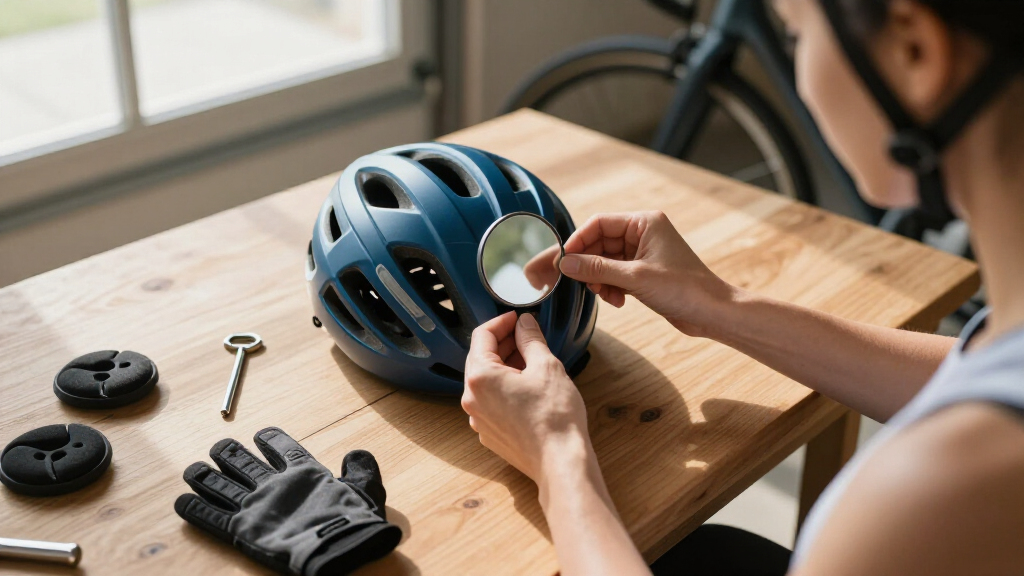
I judged every mirror against four factors that actually decide whether a helmet mirror stays on a helmet and gets used. Mount security came first: a mirror that shifts its aim every few miles is worse than no mirror, so I weighted mechanical clamps and proven adhesive systems above generic stick-on pads. Image quality came second — flat, distortion-free glass lets you judge how fast a car is closing, while curved acrylic shrinks and warps the view. Adjustability covered both range of motion and whether joints stay stiff enough to hold position on rough pavement. Finally, weight and durability mattered because a mirror adds rotational weight to your head, and fragile arms break the first time a helmet gets dropped.
The ranking logic follows use case rather than price. Products that solve the core problems — staying put, holding aim, showing a true image — rank highest regardless of cost. Value picks earn their place by being good enough at a fraction of the price, not by being cheap. Mirrors with clever features but weak mounts rank lower, because a lost or misaligned mirror fails at its one job. Where two products are nearly identical, the tiebreaker went to arm reach, replacement-part availability, and how forgiving the mount is across different helmet shapes.
Factors to Consider When Choosing Bicycle Helmet Mirror
Before picking a specific mirror, it helps to understand what actually separates a mirror you’ll forget is there from one you’ll rip off in frustration within a week. These are the factors that shaped my ranking — and the mistakes I see buyers make most often.
Mount Type: The Decision That Matters Most
Your choice of mount determines almost everything else about the ownership experience. Adhesive mounts let you place the mirror exactly where your field of vision wants it, but helmet shells are curved, sweaty, and often coated with finishes that shed tape over time — clean the surface with alcohol first and press for a full minute, or the mirror will migrate within days. Clamp and screw mounts bite onto helmet vents or shell edges and hold their aim through washboard roads, at the cost of limited placement options. Eyeglass mounts sidestep the helmet entirely and move naturally with your head, though they add weight to your sunglasses and won’t work with every frame. The most common mistake is buying a vent-clamp mirror for a helmet with unusual vent geometry — check your helmet before ordering, not after.
Glass vs. Acrylic: Why Image Quality Is a Safety Feature
Most buyers never think about mirror material until they’re squintting at a warped reflection halfway down a descent. Glass mirrors like those on the EVT Safe Zone and Take A Look render flat, true images that let you accurately judge closing speed — a car at 40 mph looks like 40 mph. Acrylic mirrors, standard on budget models, are lighter and shatterproof but curve slightly in manufacturing, producing the “funhouse” effect that shrinks vehicles and makes following distances ambiguous. Acrylic also scratches easily; a few months of helmet-on, helmet-off handling in a bag can haze the surface. If you commute in traffic daily, glass is worth paying more for. If you ride quiet paths, acrylic’s weight savings and durability may serve you better.
Adjustability and Arm Reach
“360° adjustable” appears on nearly every product listing here, but adjustability only matters if the joints stay put afterward. What separates good mirrors is joint stiffness — ball joints that hold their aim under vibration versus ones that droop after the first pothole. Arm reach is the overlooked variable: riders with narrower shoulders or recumbent positions need a longer arm to get the mirror into their natural line of sight, while a long arm on a road bike catches wind and acts like a lever in a fall. Before buying, sit on your bike in your riding position and note where your eye naturally falls — that spot, not the mirror’s default position, is what the arm must reach. Multiple stiff adjustment points beat one floppy universal joint every time.
Weight, Helmet Compatibility, and Head Fatigue
A mirror seems weightless in your hand, but it sits at the end of a lever arm from your neck, and rotational weight is felt disproportionately. Most helmet mirrors run 15–40 grams; the difference shows up on long rides as subtle neck strain, especially if the mirror is mounted far to the side. Helmet shape matters as much as weight: aero road helmets with enclosed shells often have no clean mounting surface for adhesive pads, while commuter-style helmets with pronounced vents are ideal for clamp mounts. Full-face and BMX helmets largely rule out helmet mirrors altogether — bar-end mirrors are the better route there. When in doubt, a model with multiple mounting options like the Ducameny, which includes both adhesive and O-ring hardware, hedges against incompatibility.
The Adjustment Period Nobody Warns You About
The single biggest reason helmet mirrors get abandoned isn’t product failure — it’s the learning curve. Your brain needs roughly a week of regular riding to stop treating the mirror view as a distraction and start processing it as ambient information. During that window, the mirror will feel like it’s in the way and every glance will feel like taking your eyes off the road. Set the mirror so traffic appears in the outer edge of your vision with minimal head movement, then leave it alone — constant fiddling resets the adaptation process. New riders should choose a forgiving, easily repositioned mount like an adhesive or eyeglass model for exactly this reason: you’ll re-aim it several times before finding the sweet spot, and a mount that punishes readjustment will slow that process down.
When to Pay More (and When Not To)
The price ceiling in this category is low, which changes the usual value calculus. Paying more buys you three concrete things: real glass instead of acrylic, a mount with metal components instead of all-plastic joints, and often replaceable parts — the EVT Safe Zone, for instance, lets you swap the mirror surface after a scratch instead of replacing the whole unit. What paying more does not buy you is a bigger field of view or dramatically better optics; mirror diameter physics caps that. If you ride occasionally on low-traffic routes, a two-pack of budget mirrors will serve you fine and give you a spare. If you commute daily in urban traffic, the premium models justify themselves within months through durability alone. Skip the middle of the market — the halfway-priced options tend to combine budget mounts with mid-tier pricing, the worst of both.
Frequently Asked Questions
Are helmet mirrors better than handlebar mirrors?
Each has a distinct advantage, and some riders run both. A helmet mirror moves with your head, so one small mirror covers a wide range — a slight head turn sweeps the entire road behind you, which a fixed bar mirror cannot do. Helmet mirrors also can’t be knocked out of alignment by a bumped bike at a café stop, and they transfer between bikes automatically. Handlebar mirrors win on stability and image size: they don’t vibrate with your head’s natural bobbing, and they can be physically larger without causing neck strain. If you ride one bike in traffic, a helmet mirror is usually the better single choice; if you hate anything attached to your head or wear multiple helmets, bar-mounted wins.
Will an adhesive helmet mirror fall off in hot weather or rain?
Quality adhesive mounts hold up surprisingly well if installed correctly, but installation is where most failures originate. The pad needs a clean, dry, curved-matched surface — wipe the helmet with isopropyl alcohol, apply firm pressure for a full minute, and wait several hours before riding. Heat softens cheap adhesive over time, so a mirror mounted in spring may detach in an August heatwave; parking your helmet out of direct sun extends pad life considerably. Rain alone rarely defeats a good pad, but repeated sweat exposure around the helmet’s lower edge will. This is why models like the Ducameny that include an O-ring backup mount are a sensible hedge, and why mechanical mounts rank higher in my list for daily commuters.
Left-side or right-side mounting — does it matter?
In countries where you ride on the right, traffic overtakes from behind-left, so a left-side mount lets you watch approaching cars with the smallest head movement — that’s why mirrors like the Take A Look are designed left-specific. Right-side mounting works fine but requires a larger head turn that pulls your eyes further from the road ahead. The exception is riders in left-driving countries, who should mirror the logic. Some riders also prefer mounting on their non-dominant eye side; if you close one eye naturally when checking behind, mount on that side. If a product only supports one side, check which one before ordering — several budget models in this lineup ship with symmetric mounts, but purpose-built left-side mirrors hold aim better.
How long does it take to get used to riding with a helmet mirror?
Plan on five to ten rides before the mirror feels natural rather than distracting. In the first few rides your brain treats the reflected image as a competing attention demand, and many riders experience mild disorientation or over-turning their head. The adaptation happens faster if you resist the urge to stare — the goal is glance-and-return, letting motion in the mirror’s periphery trigger a conscious check only when something changes. Resist readjusting the mirror constantly during this period; pick a position, ride three times, then fine-tune once. Riders who abandon helmet mirrors almost always quit within the adaptation window, so commit to at least a week before judging the product itself.
Can a helmet mirror replace shoulder checks before changing lanes?
No, and treating it as a replacement is genuinely dangerous. A helmet mirror has a small surface and a slightly curved or vibrating image — it tells you something is there, but it can miss fast-closing vehicles, motorcycles splitting lanes, or anything in the mirror’s blind spots. Use it the way you’d use a car mirror: for continuous awareness of what’s behind you between checks. Before any lane change, turn, or merge, still do a quick over-the-shoulder check to clear the space the mirror can’t see. The correct framing is that the mirror reduces how often you need to look back, letting you keep your eyes forward more of the time — it supplements, never replaces, a physical check.
Conclusion
Match the mirror to how you ride and the choice becomes simple. For the best overall pick, the Safe Zone Bicycle Helmet Mirror by EVT combines real glass, a rock-steady mount, and replaceable parts — it’s the mirror for riders who check behind them every single ride. The Accmor 2 Pack takes best value: not flawless optics, but two functional mirrors that cover you and a spare. For beginners, the Take A Look Cycling Mirror is the smartest entry point because eyeglass mounting makes finding the right position painless during that all-important adjustment period. On the premium end, the Third Eye Pro justifies its price with a rugged mechanical mount built for daily commuting. For specific needs: the Blackburn suits riders with vented commuter helmets who want a clamp mount, the Ducameny fits uncertain helmet shells with its dual adhesive-and-O-ring hardware, and the GOANEFIVE with its extendable arm answers recumbent or narrow-shoulder positions. Whatever you choose, give it a full week of riding before you judge — the mirror you adapt to beats the mirror you admire.
Halloween Picks

27FT Giant Inflatable Pumpkin Lighted Outdoor Halloween Decor

Kalolary 12ft Halloween Witch Haunted House Inflatable Archway

10 ft Halloween Inflatable Archway – Pumpkin, Skeleton & Candy Yard Décor
As an affiliate, we earn on qualifying purchases.