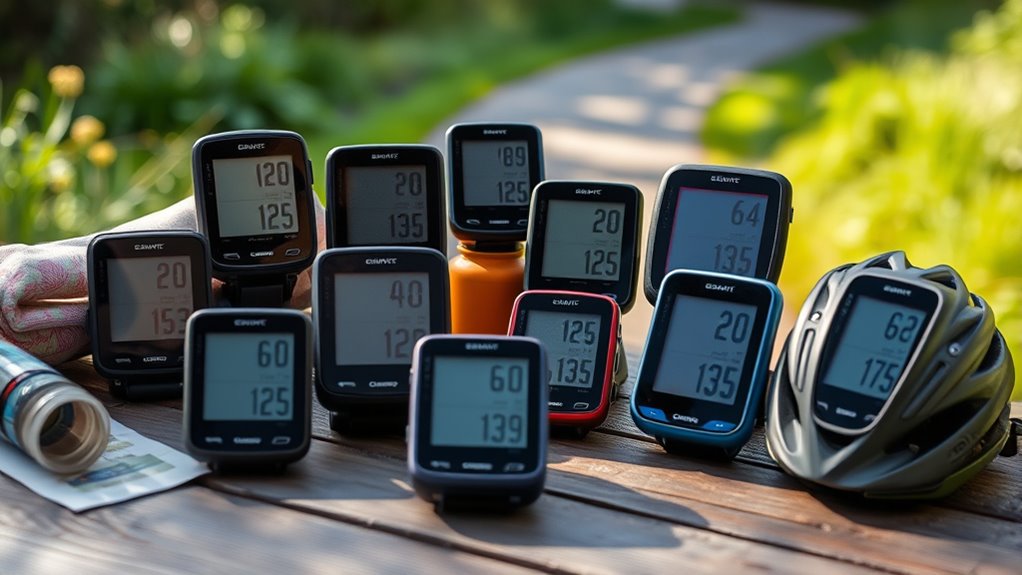

Budget bike computers range from simple wired speed displays to GPS units with route guidance, color screens, and sensor support. I’d put the iGPSPORT BSC100S forward as the best overall starting point for riders who want GPS ride data without a touchscreen premium; the CatEye Velo 7 is a simpler choice for basic speed and distance, while the COOSPO GPS models suit riders who want ANT+ sensor connections. The main tradeoff is between low-fuss essentials and the extra setup, navigation features, and charging that come with GPS computers. Screen size and water resistance also matter if you ride in varied conditions or need to read data at a glance. Read on for the full comparison and advice on matching a computer to your routes.

Get sports gear delivered free with Prime
- Fast, free delivery on millions of items
- Prime Video, Amazon Music and more included
- Member-only deals all year
Complete the kit


Key Takeaways
- GPS is the main dividing line: the CatEye Velo 7 and Urban Wireless cover basic ride metrics, while GPS models record routes and can offer navigation.
- The iGPSPORT BSC100S is the strongest all-round fit: it offers a more capable GPS feature set without the larger touchscreen focus of the BSC500 and CC700 Pro.
- ANT+ support matters when you already own sensors: the COOSPO options and several iGPSPORT models are better fits for riders building a connected setup than a basic CatEye computer.
- Large color touchscreens bring a real tradeoff: the GEOID CC700 Pro and iGPSPORT BSC500 make maps and data easier to interact with, but are more feature-heavy than simple display units.
- Product names can hide near-duplicates: this list includes two Bikevee entries and several broadly described wireless GPS models, so confirm the exact model’s navigation, sensor, and display specifications before choosing.
| Bikevee Wireless GPS Bike Computer with Bluetooth App |  | Best for App Sharing | Display: 2.4 inches | Satellite systems: GPS, BDS, GLONASS, Galileo, QZSS | Connectivity: Bluetooth | VIEW ON AMAZON | See Our Full Breakdown |
| BKVTOP Wireless GPS Bike Computer, 2.4-Inch Screen, IPX7, 28-Hour Runtime |  | Best for a Simple Standalone Setup | Screen size: 2.4 inches | Weight: 50 g | Connectivity: Standalone GPS; no app connection or external sensor support | VIEW ON AMAZON | See Our Full Breakdown |
| iGPSPORT BSC100S Wireless GPS Bike Computer |  | Best for Sensor-Based Training | Display: 2.6-inch anti-glare LCD | Satellite systems: GPS, BeiDou, GLONASS, Galileo, QZSS | Riding data: More than 40 metrics | VIEW ON AMAZON | See Our Full Breakdown |
| GEOID CC700 Pro GPS Bike Computer with 2.8-Inch Color Touchscreen |  | Best for Navigation | Screen: 2.8-inch color touchscreen | Storage: 4 GB | Satellite systems: GPS, BEIDOU, GLONASS, QZSS, GALILEO | VIEW ON AMAZON | See Our Full Breakdown |
| COOSPO Wireless GPS Bike Computer with Bluetooth and ANT+ |  | Best Compact ANT+ Pick | Display: 2.4-inch LCD | Positioning: GPS and Beidou | Connectivity: ANT+, Bluetooth | VIEW ON AMAZON | See Our Full Breakdown |
| CATEYE Urban Wireless Bike Computer |  | Best for Straightforward Tracking | Display data: Current, maximum, and average speed; total and trip distance; elapsed time; calories; clock | Sensor: Wireless analog speed sensor | Sensor range: 70 cm | VIEW ON AMAZON | See Our Full Breakdown |
| Bikevee Wireless GPS Bike Computer with Bluetooth App |  | Best for App-Based Ride Tracking | Display: 2.4-inch LCD | Battery life: Up to 28 hours | Weight: 50 g | VIEW ON AMAZON | See Our Full Breakdown |
| Wireless GPS Bike Computer with 2.4-Inch Screen |  | Best for Sensor-Free Setup | Display: 2.4-inch LCD with automatic backlighting | GPS: Built-in | Battery capacity: 650 mAh | VIEW ON AMAZON | See Our Full Breakdown |
| CYCPLUS G1 Wireless GPS Bike Computer |  | Best for Long Rides Between Charges | Display: 2-inch LED, FSTN backlit | Battery capacity: 1200 mAh | Battery life: More than 55 hours stated; 50 hours listed | VIEW ON AMAZON | See Our Full Breakdown |
| GEOID CC700 Wireless Bike Computer |  | Best for Navigation and Training Features | Display: 2.8-inch color screen | Connectivity: ANT+, Bluetooth, Wi-Fi | GPS systems: GPS, BeiDou, GLONASS, QZSS, Galileo | VIEW ON AMAZON | See Our Full Breakdown |
| COOSPO Bike Computer GPS Wireless, ANT+ Cycling Computer GPS with Bluetooth, Multifunctional ANT+ Bicycle Computer GPS with 2.4 LCD Screen, Bike Speedometer with Auto Backlight IP67 |  | Best for Sensor Compatibility | Display: 2.4-inch FSTN glass screen | Positioning: GPS with two global positioning modes | Sensor connectivity: ANT+ heart rate, speed, cadence, and power sensors | VIEW ON AMAZON | See Our Full Breakdown |
| iGPSPORT BSC500 GPS Bike Computer with 3.3-Inch Touchscreen and Voice Navigation |  | Best for Navigation | Screen: 3.3-inch touchscreen | Controls: Touchscreen and buttons | Data display: Up to 12 cycling data points per page | VIEW ON AMAZON | See Our Full Breakdown |
| CatEye Velo 7 Wired Bike Computer |  | Best for Beginners | Display: 2.17-inch LCD | Connectivity: Wired speed sensor | Tracked stats: Current, maximum, and average speed; total and trip distance; elapsed time; pace arrow; clock | VIEW ON AMAZON | See Our Full Breakdown |
| iGPSPORT BSC300T Wireless Bike Computer GPS with Touchscreen and Offline Map Navigation |  | Best for Offline Maps | Screen: 2.4-inch touchscreen | Navigation: Offline map downloads, route preview, and turn prompts | Satellite support: GPS, Beidou, GLONASS, Galileo, and QZSS | VIEW ON AMAZON | See Our Full Breakdown |
| iGPSPORT BSC200S GPS Bike Computer with Route Navigation |  | Best for Long Rides | Display: 2.4-inch semi-transparent, semi-reflective color screen | Water resistance: IPX7 | Connectivity: Bluetooth and ANT+ | VIEW ON AMAZON | See Our Full Breakdown |
| budget bike computer | Connectivity | Display | Water resistance |
|---|---|---|---|
| Bikevee Wireless GPS Bike Comp | Bluetooth | 2.4 inches | IPX7 |
| BKVTOP Wireless GPS Bike Compu | Standalone GPS; no app connection or external sensor support | — | IPX7 |
| iGPSPORT BSC100S Wireless GPS | Bluetooth 5.0 and ANT+ | 2.6-inch anti-glare LCD | IPX7 |
| GEOID CC700 Pro GPS Bike Compu | WiFi, Bluetooth, ANT+ | — | IPX7 |
| COOSPO Wireless GPS Bike Compu | ANT+, Bluetooth | 2.4-inch LCD | — |
| CATEYE Urban Wireless Bike Com | — | — | — |
| Bikevee Wireless GPS Bike Comp | Bluetooth | 2.4-inch LCD | IPX7 |
| Wireless GPS Bike Computer wit | — | 2.4-inch LCD with automatic backlighting | IPX7 |
| CYCPLUS G1 Wireless GPS Bike C | Wireless GPS | 2-inch LED, FSTN backlit | IPX6 |
| GEOID CC700 Wireless Bike Comp | ANT+, Bluetooth, Wi-Fi | 2.8-inch color screen | IPX7 |
| COOSPO Bike Computer GPS Wirel | — | 2.4-inch FSTN glass screen | — |
| iGPSPORT BSC500 GPS Bike Compu | — | — | — |
| CatEye Velo 7 Wired Bike Compu | Wired speed sensor | 2.17-inch LCD | — |
| iGPSPORT BSC300T Wireless Bike | ANT+ and Bluetooth 5.0 | — | — |
| iGPSPORT BSC200S GPS Bike Comp | Bluetooth and ANT+ | 2.4-inch semi-transparent, semi-reflective color screen | IPX7 |
More Details on Our Top Picks
Bikevee Wireless GPS Bike Computer with Bluetooth App
Bluetooth app and Strava sharing give this Bikevee an edge over the BKVTOP, which works as a standalone computer with no app connection. Its GPS tracks speed, distance, elevation changes, temperature, and other ride data without a wheel sensor, keeping setup simple for riders who want to skip magnets and wiring. The 2.4-inch display, automatic backlight, and IPX7 water resistance suit everyday rides in changing light and weather.
The advertised up-to-28-hour runtime is a useful fit for long rides between charges. The tradeoff is that sharing depends on a Bluetooth connection to the BIKEVEE app, so riders who want ride files without phone syncing may prefer the BKVTOP. I’d pick this model for app-connected tracking, while the iGPSPORT BSC100S offers ANT+ sensor support and longer advertised battery life for riders building a more data-rich setup.
Pros:- Tracks speed, distance, altitude, gradient, temperature, and ascent via GPS
- Works without a traditional wheel speed sensor
- Advertised battery runtime of up to 28 hours
- IPX7 water resistance and automatic backlight
Cons:- App and Strava syncing requires a Bluetooth connection
- No ANT+ sensor support is listed
- Advertised runtime is a maximum, not a guaranteed ride duration
Best for: Riders who want sensor-free GPS tracking and plan to sync rides to the BIKEVEE app or Strava.
Not ideal for: Cyclists who want a standalone device with no app dependency or who need ANT+ sensor support.
- Display:2.4 inches
- Satellite systems:GPS, BDS, GLONASS, Galileo, QZSS
- Connectivity:Bluetooth
- Battery capacity:600 mAh
- Battery runtime:Up to 28 hours
- Water resistance:IPX7
- Weight:50 g
- App compatibility:BIKEVEE app, Strava
Our verdict“Choose the Bikevee if you want straightforward GPS tracking with app and Strava syncing, and skip it if you need a sensor-connected setup.”
BKVTOP Wireless GPS Bike Computer, 2.4-Inch Screen, IPX7, 28-Hour Runtime
The BKVTOP keeps its job narrow: it uses built-in GPS to show ride and elevation data, without requiring a wheel sensor, phone app, or external sensor. That simplicity distinguishes it from the Bikevee, which adds Bluetooth app and Strava syncing, and the iGPSPORT BSC100S, which supports compatible ANT+ sensors. If you want ride numbers on the device and little else, the standalone design means fewer connections to set up.
Its 2.4-inch LCD, automatic backlight, MPH/KMH options, and IPX7 rating cover the basics for varied rides. The main compromise is fixed capability: there’s no app connection for ride sharing and no external sensor support for heart rate or cadence. Like the Bikevee, it advertises up to 28 hours of runtime, but the BKVTOP makes more sense for riders who value independence from phone syncing over connected analysis.
Pros:- Tracks ride and elevation data with built-in GPS
- Does not require a wheel sensor or external sensors
- Lightweight 50 g design with automatic backlight
- IPX7 water resistance and MPH/KMH display options
Cons:- No app connection or ride-sharing support
- Cannot pair external sensors for added training data
- Advertised runtime of up to 28 hours may vary by use
Best for: Casual riders who want GPS speed, distance, and elevation data on the device without connecting an app or sensors.
Not ideal for: Training-focused cyclists who want cadence or heart-rate sensors, ride sharing, or app-based analysis.
- Screen size:2.4 inches
- Weight:50 g
- Connectivity:Standalone GPS; no app connection or external sensor support
- Water resistance:IPX7
- Battery runtime:Up to 28 hours
- Units:MPH and KMH
- Included accessories:Standard mount, rubber pad, mounting rings, USB-C cable, user manual
Our verdict“Pick the BKVTOP for uncomplicated on-device GPS data, but choose the Bikevee or iGPSPORT BSC100S if you want connected features.”
iGPSPORT BSC100S Wireless GPS Bike Computer
Among these budget-oriented options, the BSC100S is the clearest choice for riders who want room to add training data. Its Bluetooth 5.0 and ANT+ support pair it with compatible speed, cadence, and heart-rate sensors; the Bikevee and BKVTOP rely on GPS and do not list that same sensor flexibility. More than 40 metrics and app sharing with Strava and Komoot make this a better fit for riders who want to review rides, not just glance at speed and distance.
The 2.6-inch anti-glare screen is larger than the 2.4-inch displays on the Bikevee and BKVTOP, while the advertised runtime reaches 40 hours. Those extras come with a setup caveat: sensor compatibility depends on the device supporting Bluetooth or ANT+, and the battery figure is a stated maximum. I’d choose it over the simpler BKVTOP for training data, but the GEOID CC700 Pro suits riders who prioritize maps and touchscreen navigation.
Pros:- Records more than 40 riding metrics
- Bluetooth 5.0 and ANT+ support compatible sensors
- Advertised battery life of up to 40 hours
- Shares ride data with Strava and Komoot
Cons:- Sensor pairing depends on Bluetooth or ANT+ compatibility
- Up to 40 hours is an advertised maximum
- Does not list the offline maps and touchscreen navigation offered by the GEOID CC700 Pro
Best for: Riders who want to pair compatible cadence or heart-rate sensors and share analyzed rides through an app.
Not ideal for: Cyclists who want the simplest sensor-free setup or prioritize touchscreen maps and turn prompts.
- Display:2.6-inch anti-glare LCD
- Satellite systems:GPS, BeiDou, GLONASS, Galileo, QZSS
- Riding data:More than 40 metrics
- Battery life:Up to 40 hours
- Battery capacity:600 mAh
- Charging port:USB Type-C
- Water resistance:IPX7
- Connectivity:Bluetooth 5.0 and ANT+
- App support:iGPSPORT app; ride sharing with Strava and Komoot
Our verdict“Choose the BSC100S for sensor-based ride tracking and long advertised battery life, unless maps matter more than training metrics.”
GEOID CC700 Pro GPS Bike Computer with 2.8-Inch Color Touchscreen
The CC700 Pro takes a different approach to a budget bike computer: its main draw is offline maps, turn prompts, and rerouting, rather than the straightforward ride metrics of the Bikevee or BKVTOP. A 2.8-inch color touchscreen gives routes more room on the display, while WiFi, Bluetooth, and ANT+ support connect it to devices and services. FIT export and syncing with Strava and TrainingPeaks also suit riders who want their rides in a training workflow.
This breadth makes it the most feature-heavy pick here, but it adds setup dependencies. Automatic rerouting requires the companion app, and DJI camera control is limited to Action 4 and Action 5 Pro models. The iGPSPORT BSC100S is a simpler choice if your priority is sensor-based training metrics and longer advertised battery life; the CC700 Pro makes more sense when staying on course is worth the added complexity. No battery runtime is provided in the supplied specs.
Pros:- Offline maps with turn prompts
- Automatic rerouting when connected to the companion app
- WiFi, Bluetooth, and ANT+ connectivity
- Exports FIT files and syncs with Strava and TrainingPeaks
Cons:- Rerouting depends on a connection to the designated app
- DJI camera compatibility is limited to Action 4 and Action 5 Pro
- The supplied product data does not state battery runtime
Best for: Route-focused riders who want offline maps, turn prompts, and compatibility with training platforms.
Not ideal for: Cyclists seeking a basic GPS display with a stated long battery runtime or who want rerouting without a companion app.
- Screen:2.8-inch color touchscreen
- Storage:4 GB
- Satellite systems:GPS, BEIDOU, GLONASS, QZSS, GALILEO
- Connectivity:WiFi, Bluetooth, ANT+
- Water resistance:IPX7
- Languages:11
- Data formats and services:FIT file export; Strava and TrainingPeaks sync
- DJI camera compatibility:DJI Action 4 and Action 5 Pro
Our verdict“Choose the CC700 Pro if navigation is your priority, while the iGPSPORT BSC100S is a simpler fit for sensor-based training data.”
COOSPO Wireless GPS Bike Computer with Bluetooth and ANT+
The COOSPO BC107 is a compact option for riders who want GPS tracking plus ANT+ sensor compatibility without moving up to the iGPSPORT BSC100S’s broader set of listed metrics and longer advertised runtime. Its 2.4-inch LCD keeps the handlebar display modest, and the app supports activity tracking and route mapping. GPS and Beidou positioning give it a sensor-free way to record rides, while ANT+ can add heart-rate, speed, or power data from compatible sensors.
There is a notable connection limit: despite Bluetooth app support, the listed sensors connect through ANT+ only, so Bluetooth sensors are not supported. The Bikevee is a better match for riders who mainly want app syncing without sensor expansion, while the BSC100S offers both Bluetooth and ANT+ sensor connections. COOSPO’s supplied specs also omit battery runtime and water-resistance rating, making it harder to compare for long or wet rides.
Pros:- Compact 2.4-inch LCD design
- GPS and Beidou positioning
- ANT+ compatibility with heart-rate, speed, and power sensors
- App support for activity tracking and route mapping
Cons:- Does not support Bluetooth sensor connections
- An extension mount may need to be purchased separately for some setups
- Supplied specs do not state battery runtime or a water-resistance rating
Best for: Riders with ANT+ heart-rate, speed, or power sensors who want a compact computer with app-based route mapping.
Not ideal for: Cyclists using Bluetooth-only sensors or those who need a clearly stated battery runtime and water-resistance rating.
- Display:2.4-inch LCD
- Positioning:GPS and Beidou
- Connectivity:ANT+, Bluetooth
- Sensor connections:ANT+ sensors; Bluetooth sensor connections are not supported
- Battery type:Lithium Ion
- Mounting type:Handlebar mount
- Dimensions:2.12 × 0.8 × 3.15 inches
- Weight:0.14 kg
Our verdict“Pick the BC107 if you already use ANT+ sensors and want a compact app-connected computer, but consider the BSC100S for broader sensor connectivity.”
CATEYE Urban Wireless Bike Computer
Simple, sensor-based tracking gives the CATEYE Urban a different job from the GPS models in this group. Its wireless front-wheel sensor reports speed and distance, while auto stop and calorie tracking add useful ride context without requiring a phone app. The programmable odometer is handy if you replace the computer or change its setup and want to retain a mileage figure. Compared with the CatEye Velo 7 Wired Bike Computer, the Urban avoids a cable between the sensor and display; compared with the GPS options, it needs a front-fork sensor and is limited to front-wheel use. That makes it a sensible fit for conventional road, mountain, gravel, and commuter bikes, but less flexible for unusual setups. Choose it for familiar ride stats, not GPS route or altitude data.
Pros:- Tracks current, maximum, and average speed alongside trip and total distance.
- Auto stop pauses ride tracking during breaks.
- Programmable odometer can preserve a chosen mileage value.
- Wireless sensor and FlexTight mount simplify installation compared with a wired unit.
Cons:- Front-wheel sensor placement limits compatibility with some bike setups.
- No GPS route, altitude, or gradient tracking.
- Requires a sensor and display setup rather than the sensor-free approach of the GPS models.
Best for: Riders with a standard front-wheel bike who want speed, distance, time, and calorie data without a GPS-based setup.
Not ideal for: Riders who need GPS mapping or altitude data, or whose recumbent, stationary, or other bike setup cannot accommodate a front-fork sensor.
- Display data:Current, maximum, and average speed; total and trip distance; elapsed time; calories; clock
- Sensor:Wireless analog speed sensor
- Sensor range:70 cm
- Mount:FlexTight mount
- Compatibility:Front wheel only; road, mountain, gravel, and commuter bikes
- Auto stop:Yes
- Odometer:Programmable, manual reset
Our verdict“Pick the CATEYE Urban for everyday stats on a standard front-wheel bike if you do not need GPS features.”
Bikevee Wireless GPS Bike Computer with Bluetooth App
Broad GPS metrics and app syncing make the Bikevee a stronger fit for riders who want more than basic speed and distance. It records altitude, temperature, gradient, and ascent, and its five satellite systems provide several positioning sources. At 50 g with up to 28 hours of stated runtime, it keeps the handlebar setup light while covering long rides. The key tradeoff is that managing rides and syncing them to Strava depends on the BIKEVEE app. The sensor-free Wireless GPS Bike Computer with 2.4-Inch Screen also offers a broad set of ride data and similar stated runtime, but the Bikevee explicitly adds Bluetooth app and Strava FIT syncing. Riders who want a direct, app-independent workflow should look elsewhere; those comfortable with a companion app get a more connected budget-oriented setup.
Pros:- Tracks speed, distance, altitude, temperature, gradient, and ascent.
- Supports GPS, BDS, GLONASS, Galileo, and QZSS satellite systems.
- Up to 28 hours of stated battery life and IPX7 water resistance.
- Bluetooth supports BIKEVEE app connection and Strava FIT file syncing.
Cons:- Ride record management and Strava syncing require the BIKEVEE app.
- Does not list ANT+ sensor support.
- The listed runtime is finite, so frequent or extended use requires charging.
Best for: Riders who want GPS ride metrics and plan to manage or sync their activities through the BIKEVEE app and Strava.
Not ideal for: Cyclists who avoid companion apps or want to manage and transfer ride records without relying on the BIKEVEE app.
- Display:2.4-inch LCD
- Battery life:Up to 28 hours
- Weight:50 g
- Connectivity:Bluetooth
- Satellite systems:GPS, BDS, GLONASS, Galileo, QZSS
- Water resistance:IPX7
- App compatibility:BIKEVEE app; Strava FIT file sync
- Warranty:2 years
Our verdict“Choose the Bikevee if app-based ride management and a wide range of GPS metrics matter more than an app-free workflow.”
Wireless GPS Bike Computer with 2.4-Inch Screen
Built-in GPS keeps setup simple: there is no wheel sensor or connecting cable to attach, so this computer suits riders who want to mount it and track a ride. The 2.4-inch LCD with automatic backlighting is designed to stay readable as light changes, and its listed data covers altitude, gradient, and accumulated ascent as well as basic ride metrics. It shares an up-to-28-hour runtime and IPX7 resistance with the Bikevee Wireless GPS Bike Computer, but the Bikevee adds Bluetooth app and Strava syncing; this model’s supplied details do not list app connectivity. In return, this pick keeps the feature set focused on the computer itself. Its 650mAh rechargeable battery still needs regular charging, and the absence of a wheel sensor means its tracking depends on GPS rather than a sensor-based measurement.
Pros:- Built-in GPS avoids installing a wheel sensor or running cables.
- Tracks speed, distance, ride time, temperature, altitude, gradient, and ascent.
- Automatic backlight supports visibility in changing light.
- IPX7 water resistance and USB-C charging.
Cons:- No wheel sensor for sensor-based measurement.
- Battery runtime is listed as up to 28 hours, so it requires recharging.
- The provided product data does not list app or Strava syncing.
Best for: Riders who want GPS ride records and elevation data with a simple handlebar installation and no wheel sensor.
Not ideal for: Cyclists who need app or Strava syncing, sensor-based speed measurement, or a computer with a stated runtime beyond 28 hours.
- Display:2.4-inch LCD with automatic backlighting
- GPS:Built-in
- Battery capacity:650 mAh
- Battery life:Up to 28 hours
- Water resistance:IPX7
- Charging port:USB-C
- Included accessories:Handlebar mount, rubber pad, mounting rings, USB-C cable, user manual
Our verdict“Choose this model for a sensor-free GPS setup and elevation data if app syncing is not part of your routine.”
CYCPLUS G1 Wireless GPS Bike Computer
Long stated battery life is the CYCPLUS G1’s clearest advantage in this lineup: its description claims more than 55 hours, while the specification lists 50 hours. Either figure puts it ahead of the up-to-28-hour Bikevee and sensor-free GPS computer on paper, making it a practical choice for riders who want fewer charging stops. The 2-inch backlit display is smaller than their 2.4-inch screens, and the listed ride data is more focused: time, distance, total mileage, and altitude. IPX6 water resistance covers wet-weather riding, though the other two GPS options list IPX7. Its automatic sleep mode can help conserve power when the bike is idle. I would choose it for endurance-focused tracking, while riders who want broader metrics or stronger listed water resistance may prefer one of those alternatives.
Pros:- Battery life is listed as 50 hours and described as more than 55 hours.
- Tracks ride time, distance, total mileage, time, and altitude.
- Backlit FSTN display is designed for sunlight visibility.
- Automatic sleep mode activates after 10 minutes of inactivity.
Cons:- Battery life figures differ between the description and specifications.
- Its 2-inch display is smaller than the 2.4-inch screens on the Bikevee and sensor-free GPS computer.
- IPX6 water resistance is below the IPX7 rating listed for those alternatives.
Best for: Riders who prioritize long stated battery life and basic GPS ride records over a larger display or an extensive metrics list.
Not ideal for: Cyclists who want a larger screen, IPX7 protection, or a consistent, clearly stated battery runtime.
- Display:2-inch LED, FSTN backlit
- Battery capacity:1200 mAh
- Battery life:More than 55 hours stated; 50 hours listed
- Connectivity:Wireless GPS
- Water resistance:IPX6
- Weight:70 g
- Mounting:Handlebar mount
- Warranty:Two years
Our verdict“Pick the CYCPLUS G1 if fewer charging sessions matter more to you than a larger display or broader ride metrics.”
GEOID CC700 Wireless Bike Computer
Route guidance, sensor support, and indoor training give the GEOID CC700 the broadest feature set in this batch. Its 2.8-inch color display supports turn reminders, GPX uploads, and automatic rerouting, while ANT+ and Bluetooth can connect compatible sensors. That range goes well beyond the focused ride tracking on the CYCPLUS G1, whose smaller monochrome screen and listed metrics suit riders who mainly want basic records and longer stated runtime. The CC700 can also display up to 10 pages of data and work with a smart trainer, making it a better match for cyclists who switch between road rides and structured indoor sessions. This added capability brings setup dependencies: fast GPS positioning depends on AGNSS syncing over Wi-Fi, and some features require the companion app or account linking. It is the most capable choice here, but also the most involved to configure.
Pros:- Color display supports turn reminders, GPX uploads, and automatic rerouting.
- ANT+ and Bluetooth support compatible sensors.
- Customizable display offers up to 10 pages with up to 10 data items per page.
- Smart-trainer support includes customizable power, resistance, and gradient.
Cons:- Fast GPS positioning depends on syncing AGNSS data over Wi-Fi.
- Some features require the companion app or account linking.
- Its broad navigation and training feature set involves more setup than the CYCPLUS G1’s basic tracking.
Best for: Riders who want on-device route guidance, sensor connectivity, and smart-trainer support in one computer.
Not ideal for: Cyclists who only need basic speed and distance tracking or want to avoid app setup and account linking.
- Display:2.8-inch color screen
- Connectivity:ANT+, Bluetooth, Wi-Fi
- GPS systems:GPS, BeiDou, GLONASS, QZSS, Galileo
- Navigation:Turn reminders, GPX upload, automatic rerouting
- Data display:Up to 10 pages and 10 data items per page; 108 supported data items
- Indoor training:Smart-trainer support with customizable power, resistance, and gradient
- Water resistance:IPX7
- Weight:0.21 kg
Our verdict“Choose the GEOID CC700 if you will use its route navigation and trainer features and are comfortable with app-linked setup.”
COOSPO Bike Computer GPS Wireless, ANT+ Cycling Computer GPS with Bluetooth, Multifunctional ANT+ Bicycle Computer GPS with 2.4 LCD Screen, Bike Speedometer with Auto Backlight IP67
The COOSPO suits riders who want GPS ride recording and the option to add ANT+ sensors over time. It can pair with heart rate, speed, cadence, and power sensors, giving it a broader upgrade path than the wired CatEye Velo 7, which focuses on basic ride stats. Its 2.4-inch sunlight-readable screen, automatic backlight, and IP67 protection are practical for changing weather and light. Ride files sync to Strava through the phone app, and the computer stores up to 80 hours of rides. The tradeoff is that sensors and the out-front mount are separate purchases, and first GPS positioning can take several minutes. Compared with the more navigation-focused iGPSPORT options here, this one keeps the feature set centered on recording and sensor data.
Pros:- ANT+ support for heart rate, speed, cadence, and power sensors
- Automatic backlight and sunlight-readable 2.4-inch display
- IP67 water protection for wet-weather riding
- Stores up to 80 hours of ride data and syncs activities to Strava through the app
Cons:- Sensors and the out-front mount are not included in the single-device option
- Initial GPS positioning may take 3–5 minutes
- Ride syncing and device setup depend on the CoospoRide phone app
Best for: Riders who want GPS ride records now and plan to add ANT+ heart rate, cadence, speed, or power sensors later.
Not ideal for: Cyclists who want turn-by-turn navigation or a ready-to-mount kit with sensors included.
- Display:2.4-inch FSTN glass screen
- Positioning:GPS with two global positioning modes
- Sensor connectivity:ANT+ heart rate, speed, cadence, and power sensors
- Phone connectivity:Bluetooth with CoospoRide app
- Ride storage:Up to 80 hours
- Water protection:IP67
- Activity sync:FIT file sync to Strava through the app
Our verdict“Choose the COOSPO if sensor compatibility and weather protection matter more than built-in route navigation.”
iGPSPORT BSC500 GPS Bike Computer with 3.3-Inch Touchscreen and Voice Navigation
Among these five, the BSC500 puts the most emphasis on following routes: it combines voice guidance, automatic rerouting, and turn alerts with route imports and planning. That makes it a better match for unfamiliar roads than the COOSPO, whose feature set centers on sensor data and ride recording. Its 3.3-inch touchscreen can show up to 12 data points per page, while physical buttons offer another way to control the unit. Dual-band positioning across five satellite systems is aimed at dependable location tracking, and hill previews add context before a climb. The larger screen and richer navigation bring more complexity than the CatEye Velo 7’s straightforward stats display. Buyers should also note that the supplied contents list the computer and mounting basics but no sensors, so sensor-based data requires compatible accessories.
Pros:- Voice navigation, turn alerts, and automatic rerouting
- Large 3.3-inch touchscreen with button controls
- Dual-band positioning and support for five satellite systems
- Hill climb previews and training analysis
Cons:- The advanced navigation feature set may be unnecessary for simple recreational rides
- Sensor-based ride data requires compatible sensors
- Larger touchscreen may be more than riders wanting a compact, basic display need
Best for: Riders who regularly follow imported routes and want voice prompts, rerouting, and climb previews on the device.
Not ideal for: Casual cyclists who mainly want speed and distance, or riders seeking a simple setup with minimal navigation features.
- Screen:3.3-inch touchscreen
- Controls:Touchscreen and buttons
- Data display:Up to 12 cycling data points per page
- Positioning:Dual-band L1/L5; GPS, Beidou, GLONASS, Galileo, and QZSS
- Route compatibility:iGPSPORT App, Strava, Komoot, and route files
- Navigation:Turn alerts, automatic rerouting, and voice navigation
- Additional features:Ride resumption, iClimb 2.0 hill previews, and training analysis
- Included items:Bike computer, rubber pad, two rubber bands, and user manual
Our verdict“Pick the BSC500 if guided route riding is your priority and you will make use of its navigation tools.”
CatEye Velo 7 Wired Bike Computer
The Velo 7 is the simplest pick here: it tracks the essentials without asking new cyclists to manage GPS routes, apps, or wireless sensor pairing. Its automatic stop detection pauses elapsed time and average-speed calculations when you stop, keeping those figures useful on rides with traffic lights. The wired speed sensor is a clear tradeoff. It can limit where the unit and sensor sit on the bike, while the COOSPO and iGPSPORT models offer wireless GPS-based setups and more room to grow. Still, the CatEye covers current, maximum, and average speed, distance, elapsed time, and a clock, with a stated battery life of up to three years. It makes more sense for a new rider learning basic ride stats than for someone who wants navigation or data analysis.
Pros:- Tracks useful speed, distance, and elapsed-time statistics
- Automatically pauses time and average-speed calculations when stopped
- Stated battery life of up to three years
- Compact, lightweight handlebar-mounted design
Cons:- Wired sensor connection limits installation flexibility
- No GPS navigation or wireless sensor connectivity
- Entry-level data set may not meet training or route-following needs
Best for: New cyclists who want core speed and distance stats on a straightforward handlebar-mounted computer.
Not ideal for: Riders who need GPS route guidance, wireless installation, or advanced sensor and training data.
- Display:2.17-inch LCD
- Connectivity:Wired speed sensor
- Tracked stats:Current, maximum, and average speed; total and trip distance; elapsed time; pace arrow; clock
- Battery life:Up to 3 years
- Battery type:Alkaline
- Mounting:Handlebar mount
- Dimensions:2.19 × 1.48 × 0.73 inches
- Weight:1.12 ounces
Our verdict“Choose the Velo 7 for uncomplicated ride stats, and look to the COOSPO or iGPSPORT models for GPS or navigation.”
iGPSPORT BSC300T Wireless Bike Computer GPS with Touchscreen and Offline Map Navigation
The BSC300T is the pick for riders who want maps available on the device and broad data coverage across different bikes. Its offline map navigation and turn prompts can help when a phone connection is inconvenient, while ANT+ and Bluetooth 5.0 support a range of compatible sensors. It also lists road, mountain, and e-bike compatibility, giving it a wider stated fit than the CatEye Velo 7’s basic speed-sensor setup. The 2.4-inch touchscreen is smaller than the BSC500’s 3.3-inch display, but the BSC300T offers over 130 riding metrics and global satellite coverage. That depth may be excessive for casual riders, and the product information does not specify battery life. New users should expect more setup than with a basic wired computer.
Pros:- Offline maps, route previews, and turn prompts
- ANT+ and Bluetooth 5.0 sensor connectivity
- Supports road, mountain, and e-bike use
- Provides over 130 riding data metrics
Cons:- Setup may be complex for riders new to cycling computers
- Battery life is not specified in the provided product information
- Extensive metrics and navigation may be more than casual riders need
Best for: Multi-bike riders who want offline route maps, sensor support, and detailed ride metrics across road, mountain, or e-bike outings.
Not ideal for: Casual cyclists who only need speed and distance, or riders who need a stated battery runtime before choosing.
- Screen:2.4-inch touchscreen
- Navigation:Offline map downloads, route preview, and turn prompts
- Satellite support:GPS, Beidou, GLONASS, Galileo, and QZSS
- Connectivity:ANT+ and Bluetooth 5.0
- Supported bikes:Road, mountain, and e-bike
- Data metrics:Over 130 riding metrics
- Listed data:Speed, distance, grade, cadence, calories, time, and temperature
- Tracking:Real-time tracking
Our verdict“Choose the BSC300T if offline mapping and broad bike compatibility matter more than a simpler interface or known battery runtime.”
iGPSPORT BSC200S GPS Bike Computer with Route Navigation
The BSC200S combines route guidance with a specified up-to-25-hour battery life, making it a practical fit for long outings where frequent charging is inconvenient. Its 2.4-inch color display is designed for sunlight visibility, and route planning, imported routes, back-to-start, and ride-record navigation cover more than the basic tracking offered by the CatEye Velo 7. It also supports Bluetooth and ANT+, over 100 data fields, and compatible lights and radar. Compared with the BSC300T, the BSC200S lists a concrete battery runtime and 400 hours of ride storage, while the BSC300T specifically offers offline maps and over 130 metrics. Some navigation and notifications depend on the iGPSPORT app, and only some app alerts are supported.
Pros:- Stated battery life of up to 25 hours
- Route planning, route imports, back-to-start, and ride-record navigation
- Sunlight-readable 2.4-inch color display with IPX7 water resistance
- Bluetooth and ANT+ support with compatible lights and radar
Cons:- Some navigation and notification features rely on the iGPSPORT app
- Only some app notifications are supported
- Product details specify route navigation but do not list offline maps
Best for: Riders taking long day trips who want route tools, extended stated battery runtime, and room to store ride records.
Not ideal for: Cyclists who require offline map navigation or want phone notifications to work independently of the iGPSPORT app.
- Display:2.4-inch semi-transparent, semi-reflective color screen
- Water resistance:IPX7
- Connectivity:Bluetooth and ANT+
- Battery capacity:600 mAh
- Battery life:Up to 25 hours
- Charging:USB Type-C; about 1.5 hours for a full charge
- Ride data and storage:Over 100 data fields; up to 400 hours of ride storage
- Navigation:Route planning and imports, one-touch navigation, back-to-start, and ride-record navigation
- Notifications:Turn, yaw, incoming call, SMS, and some app notifications
Our verdict“Pick the BSC200S for long rides that call for route tools and a stated extended runtime, provided app-linked features suit your setup.”

How We Picked
I compared the listed computers by how well their features answer common budget-rider needs: dependable ride data, straightforward setup, readable displays, route support, sensor compatibility, weather protection, and battery runtime where stated. I gave more weight to practical usefulness than to long feature lists: GPS logging is valuable for riders who want recorded routes, while a wired or basic wireless unit can be a better match for someone who only needs speed and distance.
The ranking favors models that balance useful functions with manageable complexity. The iGPSPORT BSC100S leads as a broadly capable GPS option; the CatEye Velo 7 and Urban Wireless fill the basic-data roles; and touchscreen navigation models rank higher for riders who will use mapping, but lower for those who want a simple setup. Several entries have overlapping or sparse product naming, so I treat specifications stated in each name as clues rather than assuming unlisted features.
Factors to Consider When Choosing Budget Bike Computers
Before choosing a computer, I’d start with the job it needs to do on your rides. The categories overlap, but the right decision often comes down to whether you need route recording, sensor data, or only a clear view of basic stats.
Decide Whether You Need GPS
A GPS computer records where you ride and can calculate speed without a wheel sensor, which is useful if you change bikes or tire sizes. A wired or basic wireless computer can still show speed and distance with less menu work, though setup may depend on a wheel sensor or magnet. Riders who follow planned routes should check whether a model offers actual turn guidance or only route recording. Those functions are easy to confuse in product listings. If you mostly ride familiar streets and want a glanceable speed readout, mapping may add complexity without changing your routine. Choose based on how often you will use route data, not on the presence of GPS alone.
Check Sensor Compatibility Before You Buy
ANT+ and Bluetooth support can connect a computer to cadence, heart-rate, or other compatible sensors, but support varies by model and sensor type. If you already own sensors, check that the computer supports their protocol; a matching connector does not guarantee every metric will appear. If you do not use sensors now, avoid paying attention to compatibility as if it were a must-have. Some riders prefer to add sensors later, so a computer with both common protocols can leave that option open. Also check whether sensor pairing happens on the device or through an app. This saves time and avoids building a setup around a feature the computer cannot read.
Match the Screen to Your Riding Conditions
Screen size and layout matter most when you need to read data quickly while moving. A larger display can fit more fields or show map details, while a simpler screen may keep essential numbers clear with fewer menus. Touch controls can be convenient, but gloves, rain, and road vibration can make button controls easier to operate on some rides. Think about whether you want to see several metrics at once or just speed and distance. Mount position also affects readability, especially on a crowded handlebar. Compare display size with the mount and your normal riding posture, rather than choosing by screen size alone.
Treat Battery Life as a Route Planning Detail
GPS tracking, a bright backlight, and navigation can draw more power than a basic display, so advertised runtime is most relevant when it matches your feature use. A long stated runtime can reduce charging stops on multi-hour rides, but it does not tell you how long the computer lasts with every setting enabled. Consider how often you ride, whether you can charge between rides, and whether you want to carry a cable on longer trips. Automatic backlight can help in changing light, though it may affect power use. If your outings are short, a simpler charging routine may matter more than the largest battery figure. For longer rides, leave a margin rather than planning to use the full claimed runtime.
Choose Weather Protection for Your Actual Routes
Water-resistance labels help compare computers, but they describe tested conditions and do not make a device immune to damage. If you ride in rain, look for a stated protection rating and check that the ports and buttons are covered as described by the maker. Dust and road spray can also affect mounts and charging covers over time. A computer used only for fair-weather rides may not need the same protection as one left on the bike daily. Avoid assuming that all wireless or GPS models share the same rating. Check the exact model listing, especially where names are similar or incomplete.
Set a Feature Ceiling Before Comparing Models
It is easy to treat more metrics, maps, and screen features as automatic upgrades, but each can bring more menus and setup. Decide which three or four data points you will actually use, then choose the least complicated computer that covers them. Riders who navigate unfamiliar routes have a stronger reason to choose offline maps or voice guidance than those who follow a familiar loop. A sensor-ready unit makes sense if structured training is part of the plan. If you only need a record of distance and speed, a basic CatEye can avoid features that stay unused. This approach keeps the choice focused on riding habits rather than specification counts.
Frequently Asked Questions
Can I use a budget bike computer without a phone?
Basic wired and wireless computers can show ride data without a phone, and GPS models can often record rides independently as well. Phone apps are commonly used for setup, syncing, firmware updates, or route transfer, so the exact experience depends on the model. If you want turn guidance without carrying a phone, check whether maps or routes can be stored on the computer itself. Do not assume that Bluetooth means a phone must stay connected throughout every ride. Check the manufacturer’s instructions for which features work offline.
Is GPS more accurate than a wheel sensor for speed?
GPS estimates speed from satellite position, while a wheel sensor measures wheel rotations and can give steady speed readings when satellite reception is weak. GPS is convenient if you use the computer on multiple bikes, but tunnels, tall buildings, and dense tree cover can affect its signal. A calibrated wheel sensor can be a useful complement for riders who prioritize consistent speed data. Some computers support both approaches, but verify that the specific model does. For casual rides, either can be adequate when configured correctly.
Do I need offline maps or turn-by-turn navigation?
Offline maps are most useful when you ride unfamiliar routes where phone coverage may be unreliable or where frequent stops to check a phone would interrupt the ride. Turn guidance can make a route easier to follow, but the feature may require planning and transferring routes before departure. If you usually ride a known loop, GPS ride recording may be enough. Confirm whether a computer provides maps, simple breadcrumb guidance, or only route tracking, since those are different capabilities. A larger display can help with map reading but may add bulk and interface complexity.
Will a budget computer work with my cadence or heart-rate sensor?
It depends on both the computer and the sensor protocol. Check for explicit ANT+ or Bluetooth sensor support and confirm that the specific cadence or heart-rate sensor uses a compatible protocol. A computer can have Bluetooth for app syncing without accepting Bluetooth sensors, so the word Bluetooth alone is not enough. If you plan to buy sensors later, choose a unit that supports the types you expect to use. Pairing and displaying the data are separate steps, so check both in the product documentation.
Should I choose a wired computer if I want the simplest setup?
A wired model such as the CatEye Velo 7 can be a straightforward fit if your main needs are basic speed and distance and you do not want GPS or app features. It does require correct sensor and magnet placement, and the wire must be routed cleanly along the bike. A wireless basic unit avoids that cable, though it may still need sensor positioning or pairing. GPS removes the wheel-sensor setup on many models but brings charging and signal considerations. Compare the setup you would rather maintain, not just the number of steps on day one.
Conclusion
For the broadest mix of useful ride data and manageable complexity, I’d choose the iGPSPORT BSC100S as best overall. The CatEye Velo 7 is my best value in function terms for riders who only need core stats, and the iGPSPORT BSC500 is the best premium-style pick here for riders who will use its larger touchscreen and voice navigation. Beginners who want simple operation should look at the CatEye Urban Wireless or Velo 7, while riders who want sensor connections should compare the COOSPO models and confirm protocol support. For map-focused rides, the GEOID CC700 Pro and iGPSPORT BSC300T are the more specialized options; choose between them by checking route features and controls on the exact model listing.
Columbus Day / Indigenous Peoples' Day Picks
long weekend sales
As an affiliate, we earn on qualifying purchases.