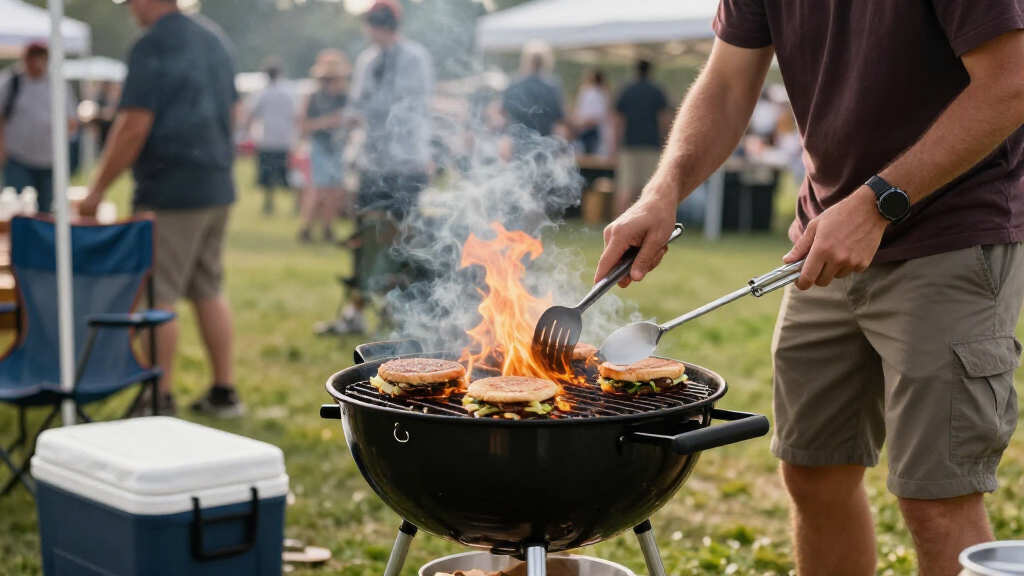

The best tailgating portable grill for most people is the Weber Traveler Compact, which pairs a generous grilling surface with a fold-flat design that fits in a trunk next to coolers and chairs. If you want more raw cooking power for a crowd, the Coleman RoadTrip 285 brings three adjustable burners and stand-up convenience, while the Royal Gourmet GT1001 covers the budget end without cutting the cooking area down to something useless. The main tension in this category is power and surface area versus portability: stand-up propane models cook for ten people but weigh 40+ pounds, while tabletop units under 15 pounds trade capacity for easy carrying. Charcoal options like the Weber Smokey Joe add flavor but demand more setup time in a parking lot. Read on for the full breakdown of all eleven models.

Get sports gear delivered free — and shop member deals
- Fast, free delivery on millions of items
- Access to Prime Big Deal Days deals on October 6–7
- Prime Video, Amazon Music and more included
Complete the kit


Key Takeaways
- The Weber Traveler Compact earned the top spot because it’s the only model that nails all three tailgating essentials at once: one-handed folding, a large usable grilling surface, and even heat across the grates.
- The Coleman RoadTrip 285 appears repeatedly in this category for good reason — its three-burner design is the best choice for cooking different foods at different temperatures simultaneously, but its weight and bulk make it a two-person lift.
- Tabletop grills under $100, like the Royal Gourmet GT1001 and Cuisinart 8,000 BTU model, are honest about their limits: they feed 2-4 people well but struggle with wind and large batches.
- Charcoal only makes sense for early-arriving tailgaters — the Weber Smokey Joe delivers better flavor than any gas model here, but 30+ minutes of startup time rules it out for pre-game rush cooking.
- The Char-Broil Grill2Go X200 is the most durable pick thanks to its die-cast construction and lid latch, making it the safest bet for anyone who transports their grill loose in a truck bed.
- BTU ratings mislead buyers more than any other spec — a 20,000 BTU two-burner grill with poor heat distribution cooks worse than a well-designed single-burner at 10,000 BTU.


| tailgating portable grill | Fuel Type | Material | Cooking Surface Area | Main Burner Count |
|---|---|---|---|---|
| Cuisinart Outdoor Gas Grill | — | Stainless steel | — | — |
| Coleman RoadTrip 285 Portable | Gas (16.4 oz. propane) | Stainless steel, powder coated finish | 285 sq. in. | — |
| Royal Gourmet GT1001 Stainless | Gas | Stainless steel with chrome-coated grate | — | 1 |
| Coleman RoadTrip 285 Portable | Propane | — | 285 sq. in. | — |
| Charbroil Grill2Go X200 Portab | Gas | — | 200 square inches | 1 |
| Cuisinart Petite Gourmet Porta | Gas | — | — | 1 |
| Cuisinart Portable Gas Grill w | Gas | — | 146 square inches | — |
| Weber Smokey Joe 14-Inch Porta | Charcoal | Alloy steel with porcelain enamel finish | — | — |
| Coleman RoadTrip 285 Portable | — | Cast iron | 285 square inches | 3 adjustable burners |
| Weber Traveler Compact Portabl | Propane | — | — | 1 |
| Charbroil Portable Convective | Propane gas | Steel with porcelain-coated grates | 190 square inches | 1 |
More Details on Our Top Picks
Cuisinart Outdoor Gas Grill, 20,000 BTU, Portable, 2-Burner
This model earns the top spot because it hits the sweet spot most tailgaters actually need: real two-zone cooking at a carry weight of just 22 pounds. The independent dual burners let you sear burgers on one side while warming buns on the other — something the single-burner Royal Gourmet GT1001 simply can’t do, no matter how much griddle space it offers. Compared with the Coleman RoadTrip 285, it gives up the stand-up cart and wheels but shaves nearly 25 pounds off the load, which matters when your grill lives in a trunk next to coolers and chairs. The electronic twist-start ignition fires reliably in parking-lot wind. The honest tradeoff is capacity: 275 square inches means you’re cooking in shifts once the group grows past six or so.
Pros:- Two independent burners enable true two-zone cooking
- 20,000 BTU output matches larger grills at half the weight
- Electronic twist-start ignition is reliable outdoors
- 22-pound build fits easily in a car trunk alongside gear
Cons:- 275 sq. in. of cooking space limits batch size for big groups
- Requires a separate propane tank purchase
- Open design gives up some heat retention versus lockable-lid rivals
Best for: Tailgaters who want two-zone heat control without hauling a cart-style grill to the lot
Not ideal for: Crews feeding ten or more people at once — the cooking surface forces batch cooking
- BTU:20,000
- Number of Burners:2
- Cooking Space:275 sq. in.
- Weight:22 lbs
- Material:Stainless steel
- Ignition:Electronic, twist-start
Our verdict“The best all-around pick for tailgaters who prioritize cooking control and portability over sheer capacity.”
Coleman RoadTrip 285 Portable Stand-Up Propane Grill with 3 Adjustable Burners & Instastart Ignition
If tailgating for you means a full spread — burgers, dogs, and veggie skewers all at once — this is the grill built for it. The three independently adjustable burners across 285 square inches give you more temperature zones than anything else here, and the foldable legs and wheels mean you roll it from car to spot rather than carry it. That’s the core difference from the Cuisinart two-burner: you trade 25 pounds of extra weight and a bulkier footprint for stand-up cooking comfort and finer heat control. The push-button Instastart eliminates matches entirely. Just know the convenience is real but the price is too — and you’re still buying the 16.4 oz. propane cylinders separately, which adds recurring cost the Royal Gourmet avoids with its simpler single-tank setup.
Pros:- Three adjustable burners for multi-zone cooking
- Wheels and foldable legs make setup fast at the tailgate spot
- Instastart push-button ignition needs no matches
- 285 sq. in. surface handles food for a group in one pass
Cons:- At 46.7 pounds, it’s the heaviest option in this lineup
- Only runs on 16.4 oz. propane cylinders, limiting fuel flexibility
- Propane cylinder sold separately
Best for: Tailgaters with a dedicated vehicle who want stand-up, three-zone cooking for a crowd
Not ideal for: Anyone walking blocks from parking to the lot — 46.7 pounds with gear is a chore even with wheels
- BTUs:20,000
- Burner Count:3
- Cooking Surface Area:285 sq. in.
- Dimensions:30.25″D x 19.19″W x 16.13″H
- Weight:46.7 pounds
- Fuel Type:Gas (16.4 oz. propane)
- Material:Stainless steel, powder coated finish
- Warranty:3-year limited
Our verdict“The closest thing to a full backyard grill you can tow to a tailgate — if you have the cargo space and budget for it.”
Royal Gourmet GT1001 Stainless Steel Portable Grill, 10,000 BTU, Tabletop Gas BBQ with Folding Legs and Lockable Lid
This is the pick when the budget matters more than burner count. The GT1001 matches the Coleman RoadTrip 285’s 285 square inches of cooking area at a fraction of the price, and its folding legs plus lockable lid make it genuinely grab-and-go in a way the 46.7-pound Coleman can’t match. The catch is heat: a single 10,000 BTU burner is half the output of the Cuisinart two-burner, so you’re working with one uniform temperature and longer preheat times. That’s fine for dogs, burgers, and kebabs; it’s frustrating if you want to sear and warm simultaneously. The removable grease tray is a small feature that pays off every single cleanup. For first-time tailgaters or casual once-a-season grillers, the value math here is hard to beat.
Pros:- 285 sq. in. of cooking area rivals grills costing far more
- Folding legs and lockable lid make transport simple
- Removable grease tray speeds cleanup at the end of the day
- Built-in temperature gauge helps track heat without lifting the lid
Cons:- Single 10,000 BTU burner limits heat output and zone control
- Warming rack is small relative to the main grate
- Preheat times run longer than dual-burner rivals
Best for: Budget-conscious or first-time tailgaters who want maximum cooking area per dollar
Not ideal for: Grillers who want multi-zone cooking — one burner means one temperature, period
- BTU:10,000
- Main Burner Count:1
- Cooking Area:285 sq. inches
- Dimensions:17.32″D x 27.36″W x 14.37″H
- Fuel Type:Gas
- Material:Stainless steel with chrome-coated grate
- Features:Folding legs, lockable lid, removable grease tray
Our verdict“The smartest spend for casual tailgaters who need surface area and portability, not burner sophistication.”
Coleman RoadTrip 285 Portable Stand-Up Propane Grill, Blue, with 3 Adjustable Burners & Instastart Ignition
Functionally, this blue RoadTrip 285 is the same machine as the stainless version — three burners, 20,000 BTUs, wheeled fold-down legs — so the choice between them comes down to finish and price on any given day rather than performance. Where it stands apart from the rest of this lineup is commitment: it’s the grill for a group that tailgates every weekend and treats the parking lot like a second kitchen. Unlike the tabletop Royal Gourmet, you’re not hunting for a truck bed or picnic table to cook on — it stands on its own. The three-burner layout means salmon, sausages, and vegetables can each get their own heat level. The drawbacks mirror its sibling: it’s heavy, propane-only, and cylinder-fueled, so it rewards squads with a storage plan and penalizes spontaneous solo trips.
Pros:- Three adjustable burners handle multi-dish menus at once
- Quick-fold legs and wheels make repeated setups painless
- Stand-up design means no table hunting at the lot
- 3-year limited warranty reflects durable build quality
Cons:- Heaviest grill in the roundup at 46.7 pounds
- Propane cylinder required but not included
- No fuel flexibility beyond standard propane cylinders
Best for: Regular tailgate crews who cook varied menus weekly and can store and transport a full-size portable rig
Not ideal for: Solo grillers or couples — the size and weight are overkill for small meals
- BTUs:20,000
- Burner Count:3
- Cooking Surface Area:285 sq. in.
- Dimensions:30.25″D x 19.19″W x 16.13″H
- Weight:46.7 pounds
- Fuel Type:Propane
- Color:Blue
- Warranty:3-year limited
Our verdict“A recurring-season investment for dedicated tailgate groups that cook like they’re at home.”
Charbroil Grill2Go X200 Portable Gas Grill, Dark Grey
This option makes the most sense for tailgaters whose gear takes abuse — tossed in a truck bed, stacked under chairs, rained on. The cast-aluminum body and non-stick grate shrug off treatment that would warp thinner steel, and the patented Amplifire cooking system is the real differentiator: it’s engineered to reduce flare-ups and keep food juicy, which no other grill in this lineup claims to address. Capacity is the honest tradeoff. At 200 square inches, it’s the smallest surface here — roughly eight burgers — so the Coleman RoadTrip 285 beats it handily for crowds. But at 24 pounds in a suitcase-style form, it’s easier to sling into a truck than the Cuisinart’s open-frame design, and the 5-year burner and lid warranty signals confidence the others don’t match.
Pros:- Amplifire system reduces flare-ups and keeps food juicier
- Cast-aluminum construction tolerates rough transport
- Suitcase-style build is easy to carry and store
- Strong 5-year warranty on burner and lid
Cons:- Smallest cooking surface in the lineup at 200 sq. in.
- No side shelves or prep storage
- Single burner offers no multi-zone cooking
Best for: Truck-bed tailgaters and adventurous cooks who need a durable, flare-up-resistant grill over raw capacity
Not ideal for: Large groups — 200 square inches means cooking in multiple rounds
- Cooking Surface Area:200 square inches
- Main Burner Count:1
- Fuel Type:Gas
- Item Weight:24 pounds
- Dimensions:24.8 x 26 x 15.7 inches
- Materials:Cast aluminum frame, non-stick finish
- Warranty:5 years burner/lid, 1 year parts
Our verdict“The pick for durability-focused grillers who’d rather cook slightly smaller batches on a grill that survives years of tailgating.”
Cuisinart Petite Gourmet Portable Gas Grill with VersaStand
The VersaStand is what separates this grill from every other tabletop option here. Most compact grills, like the Cuisinart 8,000 BTU locking-lid model, leave you hunting for a picnic table or hauling a separate folding stand. This one converts from tabletop to freestanding in seconds, which matters when a tailgating lot has nothing flat and clean to cook on. The 150-square-inch grate holds about eight burgers at once, putting it ahead of most sub-$100 portables in usable space. The catch is power: at 5,500 BTU, it’s the weakest burner in this batch, so expect longer preheat times than the 8,000 BTU Cuisinart and no real searing capability. Cooking for six or more hungry fans will mean working in shifts.
Pros:- VersaStand eliminates the need for a picnic table or separate stand
- 150 sq. in. grate fits up to 8 burgers
- Twist-to-start ignition lights reliably
- Folds into a compact unit for trunk storage
Cons:- 5,500 BTU output is the lowest in this batch, slowing preheat and searing
- Single burner offers no zoned cooking
- Stand setup and folding take more effort than a simple latch-lid grill
Best for: Tailgaters who arrive at lots without tables and want a grill that stands on its own without extra gear
Not ideal for: Groups feeding more than five or six people — the single low-output burner slows high-volume cooking
- Cooking Surface:150 sq. in.
- BTU:5,500
- Fuel Type:Gas
- Main Burner Count:1
- Stand:VersaStand converts tabletop to freestanding
- Item Dimensions:19.5″D x 30″W x 30.25″H
Our verdict“Buy this if your tailgating spots lack table space; skip it if you cook for crowds or want serious heat.”
Cuisinart Portable Gas Grill with Locking Lid, 8,000 BTU, 10 lbs.
This is the price-to-performance champion of the portable gas grills here. At roughly half the cost of the Weber Traveler Compact, it delivers 8,000 BTU — nearly matching the Weber’s heat in a package that weighs just 13 pounds. The locking lid doubles as a carry handle, so moving it from trunk to tailgate is a one-trip job, and the tool-free setup means you’re cooking within minutes of parking. Compared with the Petite Gourmet’s 5,500 BTU, the extra output translates to faster preheats and better burger crusts. What you give up is capacity and control: 146 square inches is the smallest cooking surface among the gas models here, and there’s no fine temperature adjustment, so it’s essentially one heat setting managed by lid position.
Pros:- 8,000 BTU burner heats quickly and evenly for the price
- 13-pound weight with locking lid makes transport effortless
- Tool-free setup and dishwasher-safe parts simplify cleanup
- Undercuts premium portables significantly on price
Cons:- 146 sq. in. surface is tight for groups larger than three
- No adjustable power levels — heat is managed indirectly
- Single burner rules out simultaneous direct and indirect cooking
Best for: Budget-minded tailgaters and campers cooking for two or three who want fast heat without spending Weber money
Not ideal for: Buyers who want zoned cooking or capacity for a crowd — one burner and 146 sq. in. won’t keep up
- Cooking Surface Area:146 square inches
- BTU:8,000
- Fuel Type:Gas
- Item Weight:13 pounds
- Materials:Enameled steel
- Item Dimensions:20.5 x 12 x 10.2 inches
Our verdict“The smart money pick for small groups who prioritize heat and portability over capacity.”
Weber Smokey Joe 14-Inch Portable Charcoal Grill, Black
This is the only charcoal grill in the lineup, and that distinction is the whole story. At 8.4 pounds, it’s the lightest pick here by a wide margin — less than a fifth of the Coleman RoadTrip 285’s 46.7 pounds — and the Tuck-N-Carry lid lock doubles as a handle, so it goes anywhere. Charcoal also delivers a smoky flavor that no propane model in this roundup can match, which is why some tailgaters accept the tradeoffs. And there are tradeoffs: you’re managing coals instead of turning a knob, startup takes 20-plus minutes versus the Cuisinart 8,000 BTU’s near-instant flame, and cleanup means dealing with ash rather than wiping grates. The 14-inch grate caps you at cooking for about four people max.
Pros:- 8.4 pounds makes it the lightest and cheapest-to-run option here
- Charcoal delivers flavor no propane grill in this roundup matches
- Porcelain enamel finish resists scratches and rust
- Ash catcher keeps cleanup contained
Cons:- 20+ minute charcoal startup versus minutes for gas models
- Small grate limits capacity to roughly four people
- Fire management requires more skill than dial-based gas grills
Best for: Flavor-first tailgaters and campers who accept slower charcoal workflow for smoky results at minimal weight
Not ideal for: Anyone who wants push-button convenience — charcoal startup and ash cleanup add real time before and after the game
- Cooking Diameter:14 inches
- Fuel Type:Charcoal
- Item Weight:8.4 pounds
- Material:Alloy steel with porcelain enamel finish
- Lid Feature:Tuck-N-Carry lid lock
- Item Dimensions:16.5 x 14.2 x 17 inches
Our verdict“Choose this only if smoke flavor and featherweight portability matter more than speed and convenience.”
Coleman RoadTrip 285 Portable Stand-Up Propane Grill
If your tailgate is a party rather than a picnic, this is the only pick here built for volume. The 285-square-inch surface nearly doubles the Weber Traveler Compact’s practical capacity, and three independently adjustable burners let you sear burgers on one side while keeping dogs warm on another — a capability no single-burner model in this roundup can replicate. The quick-fold legs and wheels mean you roll it rather than carry it, though at 46.7 pounds you’ll feel it loading into a raised trunk. Instastart push-button ignition removes the matches-and-coals routine entirely compared with the Smokey Joe. The costs are real: it eats trunk space, propane cylinders are sold separately, and setup takes longer than a latch-and-go tabletop grill.
Pros:- 285 sq. in. of cooking space feeds a real crowd
- Three adjustable burners enable true multi-zone cooking
- Wheels and quick-fold legs ease transport despite the weight
- Instastart push-button ignition lights reliably
Cons:- 46.7 pounds makes it the heaviest pick here by far
- Consumes significant trunk or truck-bed space
- Propane cylinders sold separately, adding to total cost
Best for: Tailgate hosts regularly cooking for six or more who need zoned heat and full-meal capacity
Not ideal for: Sedan owners with limited trunk space or solo grillers — 46.7 pounds and a 32-inch footprint are overkill
- Cooking Surface Area:285 square inches
- Main Burner Count:3 adjustable burners
- Power Levels:3
- Ignition:Instastart push-button
- Item Weight:46.7 pounds
- Material:Cast iron
- Item Dimensions:32.1 x 18.5 x 15.45 inches
Our verdict“The crowd-feeding workhorse of this roundup — worth its bulk only if you cook for groups regularly.”
Weber Traveler Compact Portable Gas Grill
This earns the top spot because it solves the portable grill dilemma better than anything else here: it’s small enough to fit in most car trunks at 37 pounds, yet its 32-inch-wide cooking area comfortably handles a meal for four — more usable space than either Cuisinart compact while remaining far easier to manage than the Coleman RoadTrip 285. The one-handed operation and automatic lid lock mean setup is a single fluid motion, and porcelain-enameled cast-iron grates hold heat well enough for respectable searing, something the 5,500 BTU Petite Gourmet struggles with. Tradeoffs exist: there’s no built-in thermometer, so you’re cooking by feel, the single burner limits zone cooking, and the premium price stings next to the value-priced Cuisinart 8,000 BTU.
Pros:- 32-inch cooking area fits meals for four despite the compact footprint
- One-handed setup with automatic lid lock is the easiest deployment here
- Porcelain-enameled cast-iron grates retain heat for good searing
- Fits in most car trunks at 37 pounds
Cons:- No built-in thermometer forces guesswork on temperatures
- Premium price well above the Cuisinart value picks
- Single burner prevents multi-zone cooking like the RoadTrip 285 offers
Best for: Tailgaters and campers who want near-full-size cooking quality in a trunk-friendly package and will pay for it
Not ideal for: Buyers on a budget or groups larger than four — the price and single-burner capacity both cap out
- Cooking Width:32 inches (34 inches overall)
- Heating Power:3.2 KW
- Fuel Type:Propane
- Main Burner Count:1
- Item Weight:37 pounds
- Grate Material:Porcelain-enameled cast iron
- Item Dimensions:21.5 x 34 x 34.75 inches
Our verdict“The best balance of capacity, quality, and portability in this roundup — if you’ll use it often enough to justify the price.”
Charbroil Portable Convective 1-Burner Propane Gas Grill
Not every tailgater wants to spend Weber Traveler money on a grill that lives in the trunk, and that’s exactly the gap this Charbroil Portable Convective fills. At around half the price of premium portables, it still delivers 11,000 BTUs of honest heat and porcelain-coated grates that wipe clean without scrubbing — a real advantage over bare steel budget grills after a messy burger session. Compared with the Royal Gourmet GT1001, it’s a few pounds lighter and easier to carry one-handed through a parking lot, though it gives up that grill’s lockable lid for transport. The tradeoffs are real: a single burner means no separate heat zones like the Cuisinart 2-burner offers, and the 190-square-inch surface caps you at about six burgers. The 90-day warranty is the shortest in this lineup, so the low price carries some long-term risk.
Pros:- Lightweight 11-pound build folds flat and carries easily to the tailgate
- Porcelain-coated grates resist rust and clean up quickly after cooking
- Very low price point leaves budget for food and fuel
- Simple assembly with minimal tools — ready to cook in minutes
Cons:- Single burner prevents zone cooking and limits temperature flexibility
- 190 square inches of cooking space is tight for larger groups
- 90-day warranty is the shortest in this lineup
Best for: Casual tailgaters and students who want cheap, reliable gas grilling for two to four people without a big investment
Not ideal for: Crews feeding six or more, or anyone who wants multi-zone cooking — the single burner and small grate will bottleneck output
- Cooking Surface Area:190 square inches
- Heating Power:11,000 BTUs
- Fuel Type:Propane gas
- Main Burner Count:1
- Dimensions:15″ H x 24.1″ W x 12.3″ D
- Weight:11 pounds
- Material:Steel with porcelain-coated grates
- Warranty:90 days
Our verdict“Buy this if you want the cheapest path to real gas grilling at the tailgate and can live with one burner and a small grate.”
How We Picked
I judged every grill here against the realities of a tailgating lot rather than a backyard patio. That meant scoring transportability first: folded dimensions, carry weight, whether it needs a stand or a table, and how well it survives being loaded and unloaded next to coolers and gear. The second filter was cooking performance in imperfect conditions — heat output, grate size relative to total footprint, wind resistance, and how evenly each model sears burgers across the full surface.
From there I weighed setup and cleanup speed, because nobody wants to scrub grates while the game is starting, and durability factors like latches, leg design, and grate coating quality. Price-per-serving capacity mattered too: a $250 grill that feeds eight can be better value than an $80 grill that feeds three. Rankings favor models that combine several of these strengths, which is why the Weber Traveler’s balance beats the RoadTrip’s raw power and why tabletop budget picks sit lower despite their attractive price.
| tailgating portable grill | Material | Fuel Type |
|---|---|---|
| Cuisinart Outdoor Gas Grill | Stainless steel | — |
| Coleman RoadTrip 285 Portable | Stainless steel, powder coated finish | Gas (16.4 oz. propane) |
| Royal Gourmet GT1001 Stainless | Stainless steel with chrome-coated grate | Gas |
| Coleman RoadTrip 285 Portable | — | Propane |
| Charbroil Grill2Go X200 Portab | — | Gas |
| Cuisinart Petite Gourmet Porta | — | Gas |
| Cuisinart Portable Gas Grill w | — | Gas |
| Weber Smokey Joe 14-Inch Porta | Alloy steel with porcelain enamel finish | Charcoal |
| Coleman RoadTrip 285 Portable | Cast iron | — |
| Weber Traveler Compact Portabl | — | Propane |
| Charbroil Portable Convective | Steel with porcelain-coated grates | Propane gas |
Factors to Consider When Choosing Tailgating Portable Grills
Choosing a tailgating grill involves tradeoffs that don’t show up on a spec sheet. These are the factors that actually determine whether your grill becomes a game-day staple or a garage ornament.
Match Cooking Capacity to Your Real Crowd
The most common mistake I see is buying for the crowd you want rather than the one you actually feed. A grate under 200 square inches realistically handles food for two or three people per batch, which means guests wait in shifts while burger patties go cold. As a rough guide, budget 60-80 square inches of grate space per person you plan to serve during a single tailgate. Also think about batch turnover — a two-burner grill lets you move finished food to indirect heat while the next round cooks, something a single-burner model can’t do. If your group regularly exceeds six people, a stand-up three-burner model like the RoadTrip 285 justifies its extra weight. If you tailgate for two or four, that same grill is dead weight you’ll resent carrying by week five.
Propane vs. Charcoal in a Parking Lot
Gas and charcoal suit completely different tailgating styles, and picking wrong ruins the experience. Propane grills light instantly, heat in five minutes, and shut off with a knob — which matters when you’re cooking during a limited pre-game window. Charcoal delivers unmistakably better flavor and holds heat without fuel-level anxiety, but it needs 30-40 minutes to be ready and leaves you disposing of hot coals while everyone packs up. Many stadiums also restrict or ban open-flame charcoal while permitting propane, so check venue rules before buying. One overlooked factor: propane tanks run out at the worst moment, so a model with easy tank swaps or a spare-tank plan saves your day. The sweet spot for most tailgaters is a gas grill with good lid closure for wind control.
Weight and Folded Size Matter More Than You Think
A grill you can’t comfortably move alone will eventually get left home, no matter how well it cooks. Anything over 40 pounds effectively becomes a two-person carry, and wheels only help on smooth pavement — stadium lots with gravel, grass, or curbs make wheeled stands genuinely annoying. Measure your vehicle space before buying: the difference between a grill that folds flat and one that stays boxy determines whether it fits beside your cooler or requires a second trip. Tabletop models under 15 pounds win on portability but assume you’ll have a stable surface at your spot, which isn’t guaranteed. Also check whether the legs detach or fold — detachable parts are the first thing lost in a dark parking lot.
BTU Numbers Lie — Look at Heat Distribution
Buyers fixate on total BTU ratings, but raw output tells you little without context. What matters is BTUs relative to grate size and how evenly that heat spreads across the cooking surface. A 20,000 BTU grill with hot spots in the center and cold corners produces worse food than a modest single-burner with a well-designed flame tamer. Cast iron grates retain and distribute heat better than stamped steel, which shows up as better sear marks and fewer flare-ups. Wind performance matters too — models with tight-fitting lids and protected burners hold temperature in the gusty conditions common in open lots. When comparing models, look at reviewer complaints about cold spots rather than the number on the box.
Build Quality Determines How Many Seasons You Get
Tailgating grills live harder lives than patio grills — they get bounced in trunks, rained on, and assembled in the dark. That makes construction quality the difference between a three-season grill and a ten-season one. Look for metal latches instead of plastic, legs that lock positively into place, and grates with a coating thick enough to survive metal spatulas. Porcelain-coated cast iron is the sweet spot for grates; bare steel rusts within a season of outdoor storage. Check how the lid secures during transport too — a lid that pops open mid-drive scatters grease across your cargo area. Spending $50-100 more upfront on a durable model often costs less than replacing a cheap grill every two years.
Don’t Forget Cleanup and Fuel Logistics
The least glamorous consideration ends up shaping your experience the most: what happens after the last burger comes off. Removable grease trays turn a 20-minute scraping job into a two-minute wipe-down, and dishwasher-safe grates are a genuine luxury after a long day. Think through your fuel plan as well — the 1-pound propane cylinders most tabletop grills use cost far more per BTU than 20-pound tanks, and not every lot has a disposal bin for empties. Some tailgaters eventually adapt larger grills to run off a full-size tank with a hose adapter, which cuts fuel costs dramatically. Finally, consider where the grill rides home: a warm, greasy grill in a closed trunk smells up everything, so models that cool fast and latch shut earn their keep on the drive back.
Frequently Asked Questions
Is a tabletop grill or a stand-up grill better for tailgating?
It depends on your crew size and how far you walk from the car. Stand-up grills like the Coleman RoadTrip 285 eliminate the need for a table, cook more food at once, and put the cooking surface at a comfortable height — but they weigh 40+ pounds and take up serious trunk space. Tabletop models like the Royal Gourmet GT1001 are half the price, weigh under 25 pounds, and work anywhere you can set them down, though you’ll need a stable surface and patience for larger batches. If you tailgate with a truck and a group of six or more, go stand-up. If you walk a distance, cook for a few people, or already bring a folding table, a tabletop model is the smarter buy.
How many BTUs do I actually need for tailgating?
Forget the total number — compare BTUs per square inch of grate instead. Anything above 70-80 BTUs per square inch will sear burgers and cook chicken through in reasonable time; below that, you’ll wait longer and get weaker browning. A 10,000 BTU single-burner grill on 150 square inches often outperforms a 20,000 BTU model spread across a poorly designed 300-square-inch grate. Wind is the hidden factor: gusty lots can cut effective heat output dramatically, which is why tight-fitting lids and wind-resistant burner designs matter as much as raw output. For typical tailgate food — burgers, dogs, chicken, some vegetables — most quality models in this roundup have plenty of power when managed correctly.
Can I bring a charcoal grill to a tailgate?
Sometimes, but check your venue’s rules before buying. Many stadiums and stadiums-adjacent lots ban open-flame charcoal cooking while explicitly permitting propane, citing fire risk and hot-coal disposal problems. Where charcoal is allowed, models like the Weber Smokey Joe deliver flavor gas grills can’t match, but budget 30-40 minutes from lighting to cooking and plan for safe coals disposal — you can’t dump hot briquettes in a trash can. Some venues require coals to be fully extinguished and packed out, which adds real hassle at the end of the day. Charcoal makes the most sense for early-arriving tailgaters who treat the cook as part of the event rather than an obstacle before it.
How long will a 1-pound propane tank last on a portable grill?
On high heat, expect roughly 1.5 to 2 hours per pound on a typical tabletop grill — so a single 1-pound cylinder covers one solid tailgate for a small group. The math changes fast with bigger burners: a three-burner model running full tilt can drain a 1-pound tank in under an hour, which is why larger grills benefit from a hose adapter connected to a 20-pound tank. Those small cylinders also cost three to four times more per BTU than bulk propane, so frequent tailgaters save real money with an adapter hose and a full-size tank that lives in the vehicle. Always carry a spare cylinder — running out of fuel mid-cook with raw chicken on the grate is a mistake you only make once.
What’s the best budget tailgating grill under $100?
The Royal Gourmet GT1001 is the strongest value in this comparison because it keeps a legitimately usable grate size and sturdy folding legs instead of cutting the features that matter. Most ultra-cheap grills fail in predictable ways: thin grates that warp, plastic parts near heat, and burners that die after a season. What the GT1001 gives up compared to pricier picks is cooking power — at 10,000 BTUs it’s slower for big batches — and it lacks the wind resistance of latched, enclosed designs. If your budget is firm, accept those limits and cook simpler foods in smaller batches. If you can stretch to $150-250, though, models like the Cuisinart two-burner or Weber Traveler last longer and cook for more people, which often makes them the better long-term value.
Conclusion
After comparing all eleven models, the right choice comes down to who’s loading the car on Saturday morning. Best overall goes to the Weber Traveler Compact — no other grill here balances cooking surface, even heat, and one-handed portability this well, making it the default for most tailgaters. Best value belongs to the Royal Gourmet GT1001, which delivers a real cooking experience for under $100 if you cook for small groups. Best premium pick is the Coleman RoadTrip 285, whose three adjustable burners and stand-up design justify the price and weight for crowds of six or more. Best for beginners is the Cuisinart Petite Gourmet, simple enough that nothing about it intimidates a first-time grill owner. For specific needs: pick the Weber Smokey Joe if flavor trumps convenience and your venue allows charcoal, the Char-Broil Grill2Go X200 if your grill rides loose in a truck bed and needs to survive it, and the Cuisinart 8,000 BTU locking-lid model if absolute minimum weight is the priority. Whatever you choose, size the grill to your real crowd, not your aspirational one — that single decision separates grills that get used every weekend from ones that don’t.
Fall Picks
fall essentials
As an affiliate, we earn on qualifying purchases.