For most cyclists, the Insta360 X5 is the best overall pick in this lineup, pairing 8K 360 capture with a waterproof design for flexible ride footage. The DJI Osmo 360 Road Cycling First-Person Combo is a strong alternative for riders who want a cycling-focused kit, while the AKASO 360 Action Camera Cycling Combo offers a simpler route into 360 recording. The main tradeoffs are detail and reframing flexibility versus battery demand, camera bulk, and the extra editing involved after a ride. A compact POV camera such as the Insta360 GO Ultra can be easier to mount, but it does not provide full 360-degree capture. Read on for the full comparison and guidance on which option fits your riding.

Get sports gear delivered free with Prime
- Fast, free delivery on millions of items
- Prime Video, Amazon Music and more included
- Member-only deals all year
Complete the kit


Key Takeaways
- The Insta360 X5 leads for all-around ride footage: its 8K 360 recording gives more room to reframe than the lower-resolution 5.6K and 5.7K models, though higher capture resolution can add storage and editing demands.
- The DJI Osmo 360 Road Cycling First-Person Combo is the cycling-kit pick: its road-oriented bundle may reduce setup guesswork, while buyers should still check that its included mount suits their bike and riding position.
- AKASO’s two 5.7K options target approachable setups: the Cycling Combo is the straightforward cycling choice; the Motorcycle Combo adds stated AI tracking, horizon lock, and SuperSmooth stabilization, but its bundle is aimed at a different mounting use.
- GoPro MAX appears twice for different kit priorities: the Waterproof 360 Action Camera is the direct option, while the 5.6K30 kit adds an Enduro battery and 32GB card; neither listing matches the newer 8K choices for stated capture resolution.
- The Insta360 GO Ultra is the size-first exception, not a 360 substitute: its 4K, 53g wearable design suits hands-free POV clips, but its 156° field of view cannot capture a full sphere for later reframing.
| AKASO 360 Action Camera Cycling Combo |  | Best Value-Style Cycling Bundle | 360° video: 5.7K | Sensors: Dual 1/2-inch 48MP sensors | 360° photo resolution: 72MP | VIEW ON AMAZON | See Our Full Breakdown |
| Insta360 X3 360 Action Camera with 5.7K Video and 4K Single-Lens Recording | 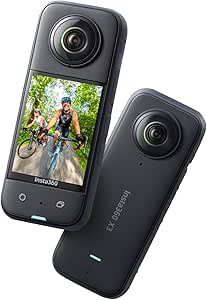 | Best for Beginners | 360° video: 5.7K Active HDR | Single-lens video: 4K | Wide-angle video: 4K at 30 fps | VIEW ON AMAZON | See Our Full Breakdown |
| DJI Osmo 360 Road Cycling First-Person Combo 360 Action Camera |  | Best for High-Detail Footage | Sensors: Dual 1-inch CMOS sensors | 360° video: Up to 8K at 30 fps | Ultra-wide video: 4K at 120 fps; 170° field of view | VIEW ON AMAZON | See Our Full Breakdown |
| AKASO 360 Action Camera Motorcycle Combo – 5.7K 360° Video, 72MP Photos, AI Tracking, Horizon Lock, SuperSmooth Stabilization |  | Best for Riders Who Already Own a Selfie Stick | 360° video: 5.7K | Photo resolution: 72MP | Sensors: Dual 1/2-inch 48MP sensors | VIEW ON AMAZON | See Our Full Breakdown |
| Insta360 X4 Air Road Cycling Bundle, 8K 360 Camera |  | Best Compact Cycling Bundle | Weight: 165 grams | Video resolution: 8K at 30 fps | Stabilization: FlowState stabilization and 360° Horizon Lock | VIEW ON AMAZON | See Our Full Breakdown |
| GoPro MAX Waterproof 360 Action Camera |  | Best for Simple, Stable 360 Cycling Footage | Spherical video: 5.6K at 30 fps | Slow-motion video: 3K at 60 fps | Single-lens video: 1080p or 1440p | VIEW ON AMAZON | See Our Full Breakdown |
| Insta360 X5 Waterproof 8K 360° Action Camera |  | Best Premium 360 Camera for Cycling | Video resolution: 8K at 30 fps | Sensors: Dual 1/1.28-inch sensors | Battery life: Up to 3 hours | VIEW ON AMAZON | See Our Full Breakdown |
| GoPro MAX 360 Action Camera 5.6K30 with Enduro Battery & 32GB Kit |  | Best Ready-to-Record GoPro Kit | Video resolution: 5.6K at 30 fps | Battery: Enduro rechargeable lithium-ion | Memory card: 32GB Extreme UHS-I microSDHC | VIEW ON AMAZON | See Our Full Breakdown |
| Insta360 GO Ultra Cycling Bundle – Small 4K Vlogging Camera, Hands-Free, POV Cam, 1/1.28″ Sensor, 53g Lightweight, 156° FOV, 200 Min Battery Life, Magnetic Wearable Action Camera for Sports and Vlogging |  | Best Compact First-Person Cycling Camera | Video: 4K; product listing also cites 4K60fps | Sensor: 1/1.28-inch sensor stated in product title | Field of view: 156° stated in product title | VIEW ON AMAZON | See Our Full Breakdown |
| cameras for cycling | Stabilization |
|---|---|
| AKASO 360 Action Camera Cyclin | 360° Supersmooth and Horizon Lock |
| Insta360 X3 360 Action Camera | FlowState Stabilization and Horizon Lock |
| DJI Osmo 360 Road Cycling Firs | — |
| AKASO 360 Action Camera Motorc | 360° SuperSmooth and Horizon Lock |
| Insta360 X4 Air Road Cycling B | FlowState stabilization and 360° Horizon Lock |
| GoPro MAX Waterproof 360 Actio | Max HyperSmooth with Horizon Lock |
| Insta360 X5 Waterproof 8K 360° | FlowState stabilization and 360° horizon lock |
| GoPro MAX 360 Action Camera 5. | Max HyperSmooth |
| Insta360 GO Ultra Cycling Bund | Hybrid image stabilization |
More Details on Our Top Picks
AKASO 360 Action Camera Cycling Combo
The AKASO 360 Cycling Combo pairs 5.7K 360° recording with an included invisible selfie stick, making it a practical choice for riders who want third-person perspectives without sourcing that accessory separately. Its 360° horizon lock and stabilization help keep footage level when the bike leans or the road gets rough, while AI tracking can follow a rider or companion for easier reframing. Compared with the Insta360 X3, it offers similar listed 5.7K capture and adds a 72MP photo mode, but the X3 specifies single-lens recording and a touchscreen. The AKASO’s main compromise is the editing workflow: its 360° footage may need processing in AKASO 360 Studio, and the supplied details do not state battery life or storage. I’d choose it for the bundled mounting perspective, not for a clearly documented ride-time or workflow advantage.
Pros:- 5.7K 360° video and 72MP 360° photos provide options for both ride clips and stills.
- Included invisible selfie stick supports third-person cycling angles without a separate accessory.
- 360° stabilization and horizon lock help level footage through turns and bumps.
- AI subject tracking can keep a rider or companion in frame during post-capture reframing.
Cons:- 360° footage may require companion software for editing and processing.
- Battery life and storage capacity are not specified in the supplied product details.
Best for: Cyclists who want a 5.7K 360 camera with an invisible selfie stick included for third-person ride footage.
Not ideal for: Riders who want clearly stated battery and storage capacity, or who prefer a camera with a documented touchscreen workflow like the Insta360 X3.
- 360° video:5.7K
- Sensors:Dual 1/2-inch 48MP sensors
- 360° photo resolution:72MP
- Stabilization:360° Supersmooth and Horizon Lock
- Subject tracking:AI-powered
- RAW photo mode:DNG8
- Included accessory:Invisible selfie stick
- Editing software:AKASO 360 Studio
Our verdict“Choose this AKASO bundle if the included invisible selfie stick matters more than a documented touchscreen or battery specification.”
Insta360 X3 360 Action Camera with 5.7K Video and 4K Single-Lens Recording
The Insta360 X3 is the more approachable pick for cyclists who want both immersive 360° footage and a conventional forward-facing option. Its 2.29-inch touchscreen gives riders a direct way to control the camera, while 4K single-lens recording can save time when there’s no need to reframe every clip. For 360° rides, FlowState Stabilization and Horizon Lock help keep the view steady and level; app-based reframing lets you choose the angle after recording. Compared with the AKASO 360 Cycling Combo, the X3 lists a screen and single-lens mode, while the AKASO includes an invisible selfie stick and specifies 72MP photos. The tradeoff here is that the X3’s 360 footage still benefits from app editing to select a final view. It suits riders who value flexible capture and straightforward camera control over the newest listed 8K option, the DJI Osmo 360.
Pros:- 5.7K 360 Active HDR recording supports immersive footage with reframing flexibility.
- 4K single-lens recording provides a simpler capture mode when a 360 view is unnecessary.
- Touchscreen makes camera control more direct than a phone-only workflow.
- FlowState Stabilization and Horizon Lock help maintain a smooth, level view.
Cons:- Choosing a preferred angle from 360 footage may require app-based reframing.
- The listed package does not include a cycling-specific mount.
Best for: New 360-camera users who want on-camera controls, a touchscreen, and the option to record conventional 4K footage.
Not ideal for: Cyclists prioritizing 8K capture or a bundled cycling mount; the DJI Osmo 360 lists 8K video, while this package lists general accessories rather than a bike mount.
- 360° video:5.7K Active HDR
- Single-lens video:4K
- Wide-angle video:4K at 30 fps
- MaxView video:2.7K at 60 fps; 170° field of view
- Stabilization:FlowState Stabilization and Horizon Lock
- Display:2.29-inch touchscreen
- Included accessories:Charge cable, protective pouch, lens cloth, and user guide
Our verdict“Pick the X3 if you’re learning 360 cycling video and want a touchscreen plus a useful single-lens mode.”
DJI Osmo 360 Road Cycling First-Person Combo 360 Action Camera
For cyclists who want the most detailed capture listed in this group, the DJI Osmo 360 stands apart with 8K/30fps 360° video, 120MP photos, and dual 1-inch sensors. That resolution gives riders more room to crop or reframe a wide scene after the ride than the 5.7K Insta360 X3 or AKASO options. Its 105GB of built-in storage also means there’s space on the camera for footage without relying solely on a removable card, and four microphones with wind-noise reduction target a common weakness in cycling video. The 183-gram body is heavier than the 165-gram Insta360 X4 Air, and the supplied details don’t identify a bike mount in the combo. One software wrinkle: DJI Mimo is not available through Google Play and must be downloaded from DJI’s site. I’d favor it for image detail and onboard capacity, not minimum weight.
Pros:- 8K/30fps 360° video and 120MP photos offer the highest listed capture resolution among these five products.
- 105GB of built-in storage provides onboard room for ride footage.
- Four microphones with wind-noise reduction are aimed at clearer outdoor audio.
- IP68 rating and waterproofing to 10 meters add protection for wet-weather use.
Cons:- At 183 grams, it is heavier than the 165-gram Insta360 X4 Air.
- DJI Mimo must be downloaded from DJI’s website rather than Google Play.
- The supplied product details do not specify a cycling mount for this combo.
Best for: Cyclists who want high-resolution 360° footage, substantial built-in storage, and audio features for documenting longer rides.
Not ideal for: Weight-conscious riders or anyone who wants an explicitly listed cycling mount and a Google Play app download.
- Sensors:Dual 1-inch CMOS sensors
- 360° video:Up to 8K at 30 fps
- Ultra-wide video:4K at 120 fps; 170° field of view
- 360° photo resolution:120MP
- Built-in storage:105GB
- Microphones:4
- Water resistance:IP68; waterproof to 10 meters
- Weight:183 grams
- Connectivity:Bluetooth, Wi-Fi 6.0, and USB 3.1
Our verdict“Choose the Osmo 360 if resolution and built-in storage matter more to you than minimizing weight or using a conventional app-store download.”
AKASO 360 Action Camera Motorcycle Combo – 5.7K 360° Video, 72MP Photos, AI Tracking, Horizon Lock, SuperSmooth Stabilization
This AKASO makes the most sense for cyclists who want 5.7K 360° recording and AI tracking but already have the mounting accessories they need. Its dual 48MP sensors, 72MP photos, and DNG8 RAW mode give it a more photo-focused specification set than the Insta360 X3, while 360° SuperSmooth and Horizon Lock are useful when road vibration and leaning would otherwise tilt the footage. Compared with the AKASO 360 Cycling Combo, the camera features are similar, but this motorcycle-combo listing says the invisible selfie stick is not included. That changes the value for cycling: riders hoping for a quick third-person setup may need to find a compatible stick separately. AKASO 360 Studio also adds an editing step, and the product description warns that its feature set may take time to learn. I’d pick it for existing AKASO users or accessory-equipped riders, rather than beginners seeking a ready-to-mount kit.
Pros:- 5.7K 360° video and 72MP photos cover both immersive ride clips and detailed stills.
- DNG8 RAW mode offers more flexibility for photo editing than a standard JPEG-only workflow.
- AI tracking can help keep a chosen rider centered when reframing.
- SuperSmooth stabilization and Horizon Lock help steady footage over uneven roads.
Cons:- Invisible selfie stick is not included, unlike the AKASO 360 Cycling Combo.
- The 360 Studio editing workflow and feature set may take time for new users to learn.
Best for: Cyclists who already own a compatible selfie stick or mount and want 5.7K 360° video with RAW photo options.
Not ideal for: First-time 360-camera buyers who want a complete third-person setup in the box; the listed selfie stick is not included.
- 360° video:5.7K
- Photo resolution:72MP
- Sensors:Dual 1/2-inch 48MP sensors
- Stabilization:360° SuperSmooth and Horizon Lock
- AI tracking:Yes
- RAW photos:DNG8 RAW
- Selfie stick:Not included
- Editing software:AKASO 360 Studio
Our verdict“Buy this AKASO if you already have a suitable mount or selfie stick; choose the Cycling Combo if you need the stick included.”
Insta360 X4 Air Road Cycling Bundle, 8K 360 Camera
At 165 grams, the Insta360 X4 Air is the lightest option here with a stated 8K 360° video mode, and its road-cycling bundle includes a bike computer mount, strap, and selfie-stick effect. That combination makes it especially suited to riders who want a compact camera setup that can shift between bike-mounted footage and floating third-person views. FlowState stabilization, Horizon Lock, and Active HDR support smoother-looking clips across changing light and road angles. Compared with the DJI Osmo 360, the X4 Air is lighter and explicitly includes cycling accessories, while DJI lists 120MP photos, four microphones, and 105GB of built-in storage. The X4 Air’s replaceable lenses are a useful repair-minded feature, but the supplied details don’t state battery life or water resistance. Insta360+ cloud storage is optional for the described backup benefit, not a substitute for confirming local storage needs.
Pros:- 165-gram weight makes it lighter than the DJI Osmo 360 for carrying on a bike.
- 8K at 30 fps captures a full 360° view for later reframing.
- Bike computer mount, strap, and selfie-stick accessory support varied cycling angles.
- Replaceable lenses can make lens damage easier to address than a fixed-lens design.
Cons:- Battery life and water resistance are not specified in the supplied product details.
- The stated cloud backup capacity depends on an Insta360+ service.
Best for: Road cyclists who want a lightweight 8K camera bundle with a bike computer mount and an included selfie-stick accessory.
Not ideal for: Riders who need confirmed battery endurance, stated water resistance, or built-in storage details before planning long or wet rides.
- Weight:165 grams
- Video resolution:8K at 30 fps
- Stabilization:FlowState stabilization and 360° Horizon Lock
- Lens design:Replaceable lenses
- Included accessories:Bike computer mount, strap, and selfie stick
- Cloud storage:Up to 2TB with Insta360+
- HDR:Active HDR
- Editing:AI editing tools in the Insta360 app
Our verdict“Pick the X4 Air if you want a lighter 8K cycling bundle with mounting accessories and can verify battery and weather needs separately.”
GoPro MAX Waterproof 360 Action Camera
The GoPro MAX is a practical choice for cyclists who want to record a ride in every direction and decide on the framing later. Its 5.6K spherical video, HyperSmooth stabilization, and Horizon Lock help keep road footage steady and level, while the Quik app can reframe clips and track a subject. Compared with the Insta360 X5, it offers less resolution and fewer high-end capture features, but its single-lens mode and included mounting pieces make it a flexible option for everyday rides. The tradeoff is that 360 footage usually needs editing before it is ready to share, and single-lens recording tops out at 1080p or 1440p. Riders who mainly want straightforward, high-resolution forward-facing video may prefer a dedicated single-lens camera.
Pros:- 5.6K spherical video captures the full scene for reframing after a ride.
- HyperSmooth stabilization and Horizon Lock help steady footage on uneven roads.
- Quik app offers reframing and automatic subject tracking.
- Waterproof body, Enduro battery, and mounting accessories are included.
Cons:- 360 footage typically needs app editing or reframing before sharing.
- Single-lens recording is limited to 1080p or 1440p.
- Lower 360 resolution than the Insta360 X5’s 8K capture.
Best for: Cyclists who want stabilized 360-degree ride footage, app-based reframing, and the option to switch to single-lens recording.
Not ideal for: Riders prioritizing the finest 360 detail or high-resolution single-lens video, since this model records 360 video at 5.6K and single-lens video at up to 1440p.
- Spherical video:5.6K at 30 fps
- Slow-motion video:3K at 60 fps
- Single-lens video:1080p or 1440p
- Photo resolution:16.6 MP
- Live streaming:1080p
- Stabilization:Max HyperSmooth with Horizon Lock
- Mounting:1/4-20 threads
- Included accessories:Enduro battery, curved adhesive mount, protective lens caps, microfiber bag, mounting buckle, thumb screw, and USB-C cable
Our verdict“Choose the GoPro MAX if stable, flexible 5.6K 360 footage matters more than 8K detail or high-resolution single-lens recording.”
Insta360 X5 Waterproof 8K 360° Action Camera
For cyclists who want maximum reframing latitude, the Insta360 X5 leads this group with 8K30fps 360 video and dual 1/1.28-inch sensors. The extra resolution gives more room to crop a ride into different angles, while FlowState stabilization and 360-degree horizon lock help keep the resulting clips smooth and level. Compared with the GoPro MAX, the X5 offers higher-resolution capture, a replaceable lens, and a wind guard aimed at cleaner audio; those upgrades matter most to riders who edit and publish regularly. They also bring more features to learn, and the camera’s stated three-hour battery life may fall short on longer recording days. This is a stronger fit for ambitious ride creators than for someone who only wants occasional clips with minimal editing.
Pros:- 8K30fps 360 capture provides more detail for cropping and reframing.
- FlowState stabilization and 360-degree horizon lock suit bumpy rides.
- Replaceable, scratch-resistant lens offers a repair-minded design.
- Four-microphone array with wind guard and AI reframing support ride videos.
Cons:- More advanced features can take time to learn.
- Three-hour stated battery life may not cover extended recording sessions.
- Higher-resolution footage and editing features may be unnecessary for casual riders.
Best for: Cyclists who regularly edit ride footage, want detailed 360 clips to crop into multiple views, and value replaceable lenses.
Not ideal for: Casual riders seeking a simple, low-effort recording setup or those who need to capture long outings without planning around the stated battery life.
- Video resolution:8K at 30 fps
- Sensors:Dual 1/1.28-inch sensors
- Battery life:Up to 3 hours
- Lens:Replaceable, scratch-resistant
- Stabilization:FlowState stabilization and 360° horizon lock
- Audio:Four-microphone array with wind guard
- Editing features:AI reframing and InstaFrame mode
- Additional feature:Invisible selfie stick support
Our verdict“Pick the Insta360 X5 for premium 8K reframing flexibility and durable lens design, provided you are comfortable with its more involved workflow.”
GoPro MAX 360 Action Camera 5.6K30 with Enduro Battery & 32GB Kit
This GoPro MAX kit suits riders who want the familiar 5.6K30 360 camera bundled with a battery and memory card, rather than choosing those pieces separately. Max HyperSmooth stabilization, horizon leveling, waterproofing, and a six-mic system make it a capable ride recorder, while the included 32GB microSD card gets a basic setup started. Compared with the standard GoPro MAX in this roundup, its appeal is the card-and-battery kit, not a higher capture ceiling: both are built around 5.6K 360 footage. That resolution can be limiting beside the 8K Insta360 X5, and 32GB may fill quickly on longer rides. Like other 360 cameras, it also asks for editing or reframing before clips look like conventional cycling video.
Pros:- Includes an Enduro battery and 32GB microSD card for a more complete starting kit.
- 5.6K30 360 video and panoramic photos capture the ride for later reframing.
- Max HyperSmooth and horizon leveling help steady cycling footage.
- Waterproof construction and a six-mic system suit outdoor recording.
Cons:- 5.6K capture offers less reframing detail than the Insta360 X5’s 8K video.
- The included 32GB card may be insufficient for extended recording.
- 360 footage requires editing or reframing for conventional ride clips.
Best for: GoPro-oriented cyclists who want a 5.6K 360 setup with an included Enduro battery and memory card for shorter rides.
Not ideal for: Riders recording long trips who need more than 32GB at hand, or creators seeking higher-resolution 360 capture than 5.6K.
- Video resolution:5.6K at 30 fps
- Battery:Enduro rechargeable lithium-ion
- Memory card:32GB Extreme UHS-I microSDHC
- Waterproof:Yes
- Stabilization:Max HyperSmooth
- Audio:Six-microphone system
- Temperature resistance:As low as 14°F
Our verdict“Choose this GoPro MAX kit if you want its 5.6K 360 format with a battery and card included, and do not need 8K detail or extensive storage.”
Insta360 GO Ultra Cycling Bundle – Small 4K Vlogging Camera, Hands-Free, POV Cam, 1/1.28″ Sensor, 53g Lightweight, 156° FOV, 200 Min Battery Life, Magnetic Wearable Action Camera for Sports and Vlogging
The Insta360 GO Ultra Cycling Bundle is the outlier here: it is a compact, hands-free POV camera, not a 360 camera. Its lightweight form and magnetic mounting are aimed at riders who want to capture the view ahead without fitting a larger 360 unit to the bike or wearing a bulky setup. The listed features include 4K video, hybrid stabilization, waterproofing, and auto editing, making it a simpler route to shareable point-of-view clips than the GoPro MAX or Insta360 X5, whose 360 footage can be reframed after recording. That simplicity comes at the cost of all-around capture: this camera’s wide-angle lens does not provide the same post-ride choice of viewpoints. Its magnetic mount may also need compatible accessories for a secure fit on a specific riding setup.
Pros:- Compact, lightweight design is suited to hands-free POV recording.
- Listed 4K video and hybrid stabilization support ride footage.
- Waterproof design is intended for outdoor use.
- Auto editing can simplify preparing clips to share.
Cons:- This is a wide-angle POV camera, not a 360 camera like the GoPro MAX or Insta360 X5.
- Magnetic mounting may not suit every bike or riding setup and can require compatible accessories.
- The bundle is listed without a microSD card.
Best for: Commuters and recreational cyclists who want a small, hands-free forward POV camera with automatic editing rather than 360 reframing.
Not ideal for: Riders specifically seeking spherical 360 footage, multiple post-recording viewpoints, or a mounting setup that works without compatible accessories.
- Video:4K; product listing also cites 4K60fps
- Sensor:1/1.28-inch sensor stated in product title
- Field of view:156° stated in product title
- Weight:53 g stated in product title
- Stabilization:Hybrid image stabilization
- Water resistance:Waterproof; listing cites up to 33 ft
- Battery life:Up to 3 hours stated in product data
- Memory:SD memory; bundle listed without a microSD card
- Lens:Fixed-focus wide-angle lens, 14.27 mm
Our verdict“Choose the GO Ultra if compact, hands-free POV footage is your priority, but skip it if you need genuine 360-degree capture.”

How We Picked
I ranked these cameras for the practical demands of cycling: stable footage over vibration, useful reframing after a ride, weather readiness, manageable mounting, and a workflow a rider can realistically keep up with. I also separated true 360 cameras from the Insta360 GO Ultra, which offers a wide POV view rather than full 360 capture, so its smaller form is treated as a distinct use case rather than a direct image-format match.
The order favors the strongest balance of capture flexibility and ride suitability, then distinguishes options by kit focus, resolution, and likely buyer fit. An included cycling bundle can simplify mounting, but it does not automatically outrank a camera with more reframing headroom. I also weighed the compromises: resolution can increase storage and editing needs, a compact body may limit capture choices, and a bundle’s value depends on whether its mounts and accessories match the rider’s setup. Where product names state a feature or bundle detail, I use that as a comparison point rather than assuming performance beyond the listed information.
Factors to Consider When Choosing 360 Cameras For Cycling
Choosing a cycling 360 camera is about more than the headline resolution. I would start with the type of footage you want to keep, then check how the camera fits your bike, ride length, weather exposure, and editing habits.
Decide Whether You Need Full 360 Capture
A 360 camera records the scene around it, letting you choose the viewing direction later; a wide-angle POV camera records a broad view from one direction. That difference matters when you want to reframe a clip after a close pass or include both the road and your surroundings. If you know you only want a forward-facing handlebar view, a conventional action camera may create less editing work. The GO Ultra in this group is compact and hands-free, but its 156° field of view is not equivalent to spherical capture. Avoid buying a 360 model just because its field-of-view language sounds broad: check whether the sensor records a full sphere. Choose the recording format based on what you plan to publish, not only the largest number on the box.
Match Resolution to Your Editing and Storage Setup
Higher 360 resolution can preserve more detail when a spherical recording is cropped into a conventional frame. That advantage is useful when you may change the shot after the ride, but it does not make every finished export look sharper automatically. Reframing, rendering, and storing large source files can take more time and device capacity than a simple forward-facing clip. Consider how often you will edit, where you will back up footage, and whether your computer or phone handles large video files comfortably. A 5.6K or 5.7K camera may be a sensible fit when your main goal is casual ride documentation rather than repeated tight crops. Do not judge a camera only by its capture resolution; stabilization, lighting, framing, and the final export also shape the result.
Plan the Mount Before Choosing the Camera
On a bicycle, mount placement changes both the view and how much vibration reaches the camera. A handlebar position can show the road clearly, while a pole or body-mounted position may reveal more of the rider and surroundings. Check whether the included bracket fits your bar diameter, accessory system, and preferred angle before treating a bundle as ready to ride. A longer mounting arm may create a more visible 360 perspective, but it can also catch wind or move more over rough surfaces. Keep the camera clear of brake cables, controls, lights, and your field of movement. For road use, verify that the mount locks securely and that the camera’s weight is suitable for the chosen position.
Treat Battery Life as a Ride-Planning Constraint
Recording continuously can use power faster than carrying a camera for short clips, and cold conditions or frequent wireless connections may add further strain. A stated battery figure is not a promise of the same recording time in every mode, so plan around your longest ride rather than a short test clip. If you expect to record a full day, check whether spare batteries, charging access, or a power bank fit your route and setup. Extra batteries also add weight and require a safe place to carry them. A kit that includes an additional battery can be useful, but the rest of its contents still need to match your needs. For shorter rides, simple controls and a reliable start-stop routine may matter more than carrying a large battery stash.
Check Weather Protection and Lens Care
Rain, road spray, dust, and grit are common cycling hazards, but a waterproof camera body does not mean every accessory or connection is equally protected. Read the maker’s conditions for the camera, doors, ports, and any external microphone or mount attachment you plan to use. Exposed 360 lenses also need careful handling: a small scratch can affect a large part of the image and may be harder to hide than damage on a forward-facing lens. Use a protective case for transport, clean lenses with suitable materials, and check for dirt before recording. Lens guards can add protection but may affect image quality or stitching, so confirm compatibility for the exact camera. Do not assume a motorcycle-oriented bundle automatically includes the right weather protection or bicycle mount.
Account for the Editing Workflow, Not Just the Ride
360 footage often needs reframing before it is ready to share, so the camera app and export process are part of the purchase decision. Think about whether you want to choose a new view for each clip or prefer footage that is ready to post with minimal work. Try a short sample file in the editing software you already use before committing to a demanding workflow. Confirm how footage transfers to your phone or computer and whether the app supports the export format you need. Riders who want quick highlights may get more value from simple controls and a repeatable preset than from every advanced mode. If you rarely edit, a standard POV camera can be the more satisfying choice even when a 360 camera offers greater framing freedom.
Frequently Asked Questions
Is a 360 camera worth it for ordinary road rides?
It can be worthwhile if you want to choose the camera angle after riding, record scenery around you, or create several views from one clip. That flexibility comes with more editing and larger files than a straightforward forward-facing recording. If you mainly want evidence of what happened ahead, a simpler POV camera may be quicker to operate and share. In this lineup, the Insta360 X5 is the strongest all-around 360 choice, while the GO Ultra suits riders who value a small wearable camera over spherical reframing. Decide how often you will actually edit before paying for the extra capture flexibility.
Can I use the Insta360 GO Ultra instead of a 360 camera?
You can use it as a compact cycling POV camera, but not as a replacement for full 360 capture. Its listed 156° field of view records a wide scene from one direction, so you cannot later rotate the view around the camera as you can with spherical footage. That makes it a useful fit for hands-free clips when size and simplicity matter more than reframing. Choose one of the actual 360 models if you want to decide after the ride whether the final shot faces forward, back, or sideways. The GO Ultra is best treated as a separate camera style within this roundup.
Should I choose 8K 360 video over a 5.6K or 5.7K model?
Choose 8K when you expect to crop or reframe footage often and want more source detail to work with. The X5 and X4 Air list 8K capture, while the AKASO models list 5.7K and the GoPro MAX kit lists 5.6K30. A higher capture figure does not remove the need for good mounting, lighting, and careful export settings. It can also mean more storage use and a heavier editing workload, so it may not help a rider who shares occasional wide clips without tight crops. Match resolution to your editing device and intended finished video rather than choosing by number alone.
Do cycling bundles include everything I need to mount the camera?
Not necessarily: a bundle name signals an intended use, but included mounts can differ in fit, length, and compatibility. Check the exact contents and confirm the clamp works with your handlebar or preferred mounting point. Also check whether a mount keeps the camera clear of controls and whether it remains secure over the surfaces you ride. The DJI road cycling combo and AKASO cycling combo may reduce setup work, but buyers should still verify the included hardware against their own bike. If you already own compatible mounts, a camera-only option may be a better fit than paying for accessories you will not use.
Which camera makes the most sense for long rides in changing weather?
Start by checking stated weather protection for the camera itself and any doors or accessories, then plan for battery and storage during your longest ride. The X5 and GoPro MAX are explicitly described as waterproof in their product names, while the other listings should be checked for their exact protection limits before wet-weather use. Waterproofing does not protect an exposed lens from grit or a poorly secured mount from vibration. The GoPro MAX kit includes an Enduro battery, which is a useful bundle distinction, but it does not by itself establish a guaranteed ride duration. Carry a safe charging or spare-battery plan and protect the lens between recording sessions.
Conclusion
For the best overall, I would choose the Insta360 X5 for its 8K 360 capture and stated waterproof design, accepting the added storage and editing workload. The best value-oriented fit is the AKASO 360 Action Camera Cycling Combo for riders who want a cycling-specific bundle without prioritizing the highest listed resolution; verify the mount contents before buying. For a premium, cycling-focused kit, consider the DJI Osmo 360 Road Cycling First-Person Combo, especially if its included setup matches your bike. The best choice for beginners is the AKASO Cycling Combo, whose straightforward cycling positioning may make the first setup easier than piecing together mounts separately. For maximum capture detail, compare the Insta360 X4 Air and X5; for compact hands-free POV, pick the GO Ultra only if full 360 reframing is not a requirement. That leaves the GoPro MAX kits and AKASO Motorcycle Combo as fit-specific alternatives for riders whose priorities match their listed bundle features.
Halloween Picks
halloween
As an affiliate, we earn on qualifying purchases.